How to Choose the Right AC Cooling Fan?
Choosing the right Ac Cooling Fan involves more than matching a fan to an opening. Airflow, static pressure, noise, power use, and available space all affect cooling performance. A fan that moves plenty of air in an open enclosure may struggle behind a dust filter or narrow grille. Small details matter.
Start with the heat-producing components and the enclosure’s airflow path. Check the fan’s dimensions, voltage, connector, and published airflow and pressure ratings. Compare specifications under similar test conditions; airflow figures alone can be misleading. Measure the mounting area, and note nearby cables, filters, and obstructions. A few millimeters can change fit or restrict intake. Quiet operation may also require a lower speed, which can reduce cooling capacity. There is no perfect fan for every setup.
Reliable selection means balancing measurable requirements with real operating conditions. Review manufacturer data, confirm compatibility with the controller or power supply, and consider dust, temperature, and expected runtime. If the system runs hot, verify temperatures after installation rather than assuming a larger fan solved the problem. Results can vary with room conditions and enclosure design. That uncertainty is worth acknowledging. This guide explains the key factors to compare, common selection mistakes, and practical ways to choose a fan that provides dependable cooling without unnecessary noise or energy use.
Identify the Cooling Task and Operating Conditions
Before choosing an AC cooling fan, define what needs cooling and where the heat builds up. A control cabinet with warm components needs a different airflow pattern from a small motor housing. Estimate the heat load, desired internal temperature, and hours of operation. Note the ambient temperature, available voltage and frequency, mounting space, and acceptable noise level.
Airflow ratings can be misleading when read alone. Filters, protective grilles, and narrow vents create resistance, reducing actual airflow. Check the fan’s performance at the system’s expected pressure, not only its free-air rating. Dust and moisture matter, too. One detail is easy to overlook: a clean test setup may not match a working enclosure. Measure temperatures under realistic conditions, and revisit the estimate if results differ.
Tips: Sketch the air path before selecting a fan. Mark the inlet, outlet, and heat sources. Keep vents clear, and allow hot air to escape rather than recirculate. If the temperature reading varies, check sensor placement; a probe beside the fan may not reflect the hottest component.
Choose a Fan Type for the Required Airflow and Pressure
A cooling fan should match the air resistance in the equipment, not just promise a high airflow number. An axial fan moves substantial air through an open grille, where resistance is low. Add a dense filter, a narrow duct, or a heat exchanger, and airflow can drop. For these systems, a centrifugal fan often maintains flow better against higher static pressure. Mixed-flow designs can be a practical middle ground.
Check the curve. A fan’s performance curve shows airflow at different pressure levels; compare it with the expected resistance of the complete air path. The operating point is where the two meet. Measure or estimate the resistance with every component installed, including grilles and filters. A clean prototype may behave differently once dust builds up. That detail is easy to miss. Also check the fan’s dimensions, voltage, speed control, and continuous-duty rating. Listen for tonal noise, especially in a quiet room. If test data is limited, leave some margin and verify temperatures under real operating conditions. A larger fan is not automatically better; poor fit or turbulent airflow can waste power and create uneven cooling.
How to Choose the Right AC Cooling Fan?
Compare typical airflow and static-pressure characteristics to narrow down the fan type for your application.
How to read this: Axial fans are commonly selected for high airflow at low resistance, while centrifugal fans are better suited to systems with higher pressure resistance. Mixed-flow fans offer a compromise. Values shown are representative examples, not fixed limits; check the fan curve against your system’s airflow and pressure requirements.
Determine the Fan Size and Airflow Capacity
Choose a fan by required airflow, not by diameter alone. A common HVAC design estimate is 350–400 cubic feet per minute (CFM) per refrigeration ton. For a 2-ton cooling load, that suggests roughly 700–800 CFM. This is a starting range, not a final specification. ACCA Manual D emphasizes matching duct design to airflow and pressure losses, so check the system’s external static pressure before selecting a fan. A compact fan may move enough air in an open test, yet struggle against a restrictive grille or dusty filter.
Fan performance curves matter. AMCA Publication 210/ASHRAE Standard 51 describes standardized methods for testing fan airflow and pressure performance. Compare rated airflow at the pressure your installation actually needs, rather than relying on a free-air CFM figure. Measure the opening, too: a 10-inch fan will not automatically suit a 10-inch cutout if its frame or guards reduce clearance. I still double-check the curve against real installation details; that step is easy to skip.
Tips: Write down the cooling load, target CFM, opening size, and estimated static pressure. Then choose a fan whose curve meets the airflow target at that pressure. Leave some margin, but avoid oversized airflow that creates noise or uneven cooling.
How to Choose the Right AC Cooling Fan? - Determine the Fan Size and Airflow Capacity
Use the ranges below as general reference values for common axial fan frame sizes. Actual airflow varies by fan design, speed, and system resistance.
| Fan Frame Size (mm) |
Typical Free-Airflow Range |
Approx. Airflow (m³/h) |
Typical Use |
Selection Consideration |
| 80 × 80 |
20–45 CFM |
34–76 |
Compact enclosures and small electronic assemblies |
Check that the limited airflow meets the equipment’s heat load. |
| 92 × 92 |
30–65 CFM |
51–110 |
Small cabinets and equipment compartments |
Confirm the mounting cutout and available fan depth. |
| 120 × 120 |
50–150 CFM |
85–255 |
General-purpose equipment cooling |
A common size; compare airflow at the required static pressure. |
| 150 × 150 |
100–250 CFM |
170–425 |
Larger cabinets and higher heat loads |
Allow space for the fan, guard, and unobstructed intake and exhaust. |
| 172 × 150 |
150–300 CFM |
255–510 |
Industrial enclosures and equipment with restricted airflow paths |
Use the fan curve to verify performance through filters, grilles, or ducts. |
| 200 × 200 |
200–400 CFM |
340–680 |
Large enclosures and applications requiring high airflow |
Check power, noise, mounting strength, and airflow distribution. |
Quick airflow estimate:
For sensible heat removal, estimated airflow (CFM) ≈ 1.76 × heat load (W) ÷ permitted air-temperature rise (°C). Treat this as a starting estimate, then select a fan that can deliver the required airflow at the system’s actual static pressure.
Note: The airflow ranges are indicative free-air values, not guaranteed operating points. Filters, grilles, ducts, and other restrictions usually reduce delivered airflow; consult the selected fan’s performance curve.
Compare Power, Noise, and Environmental Ratings
Choose a fan by its operating point, not its largest wattage. The U.S. Department of Energy’s Improving Fan System Performance sourcebook estimates that fans use about 15% of the electricity consumed by motors in U.S. manufacturing. Compare power draw at the airflow and static pressure your system actually needs. A higher-watt fan may move more air, but only a performance curve can show whether it does so efficiently. Dusty grilles and tight duct bends add resistance. Small details matter.
Noise figures need the same careful comparison. Check sound-power data measured under ISO 13347 and compare fans at similar speeds and operating conditions. A sound-pressure reading taken beside one fan cannot reliably predict noise in your room; distance, walls, and mounting all affect what people hear. Listen from the intended position. A quiet fan may still disappoint if it cannot maintain airflow against system resistance.
For environmental ratings, read the full IP code. IEC 60529 classifies protection against solid objects and water, but it does not rate corrosion resistance or temperature tolerance. For outdoor, humid, or washdown locations, check the specified ambient range, materials, and operating limits. I would not treat a high IP rating as a complete durability score. Salt air or sustained heat can still shorten service life.
Check Compatibility, Installation, and Maintenance Needs
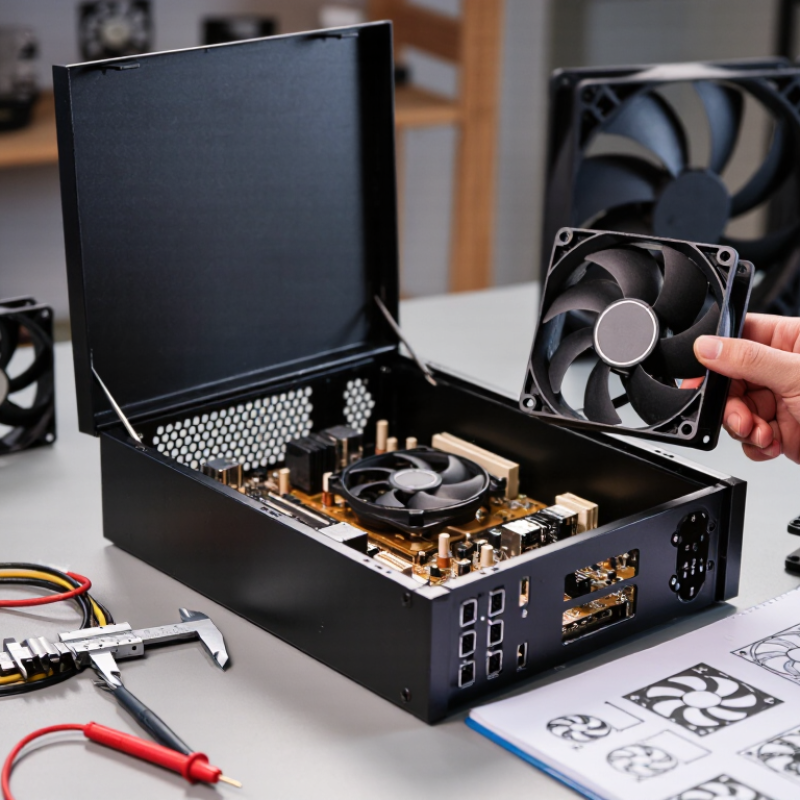
Choosing an AC cooling fan starts with the unit’s specification plate and service manual, not appearance alone. Match rated voltage, frequency, motor type, shaft dimensions, mounting pattern, and blade diameter. Airflow and rotation direction matter too; a fan that spins but pushes air the wrong way can reduce heat transfer. Check that the replacement’s current draw and capacitor requirements suit the existing controls. Looks can deceive.
Disconnect power at the breaker and confirm the unit is de-energized before opening the cabinet. If wiring, capacitors, or refrigerant-side components are unfamiliar, use a qualified HVAC technician; stored electrical charge can remain hazardous. Photograph wire connections before removal, then secure the fan and keep blades clear of guards and cables. Measure twice. After installation, check rotation, listen for rubbing, and verify steady airflow with the panels fitted. Dust, cottonwood, and grease can collect on blades and nearby coil surfaces, so clean them gently during scheduled service. Inspect for cracked blades, loose fasteners, unusual vibration, and bearing noise; a quiet fan is not always a healthy one. I would not judge the fit by the plug alone: airflow, mounting, and control compatibility deserve a second look.