How to Choose the Right DC Blower Fan?
Choosing the right Dc Blower Fan is more than matching a voltage and mounting hole. The correct model must move air through real resistance, not just perform well in an open test. In practical equipment, filters, narrow ducts, heat sinks, and protective grilles can reduce airflow significantly. A fan rated at 100 cubic feet per minute may deliver much less inside a compact enclosure.
Start with the operating conditions. Check required airflow, static pressure, voltage, current, speed control, noise, and available space. A server cabinet may need steady pressure through a dense filter. A small medical device may require low vibration and dependable speed regulation. Temperature also matters. Bearings, insulation, and electronic components should suit the expected environment. Always compare the manufacturer’s performance curve, not only the headline airflow figure.
Reliable selection also requires careful verification. Confirm connector type, rotation direction, alarm output, IP rating, and expected service life. Listen for unusual resonance during testing. Feel for excessive vibration around the mounting frame. These small observations can reveal problems that a datasheet misses. The choice is rarely perfect. I have seen teams prioritize airflow, then discover unacceptable noise after installation. That mistake is avoidable, but not always obvious. A sensible decision balances cooling performance, energy use, durability, maintenance access, and total cost. When specifications conflict, prototype the Dc Blower Fan under actual load before approving the final design.
DC Blower Fan Fundamentals and Operating Principles
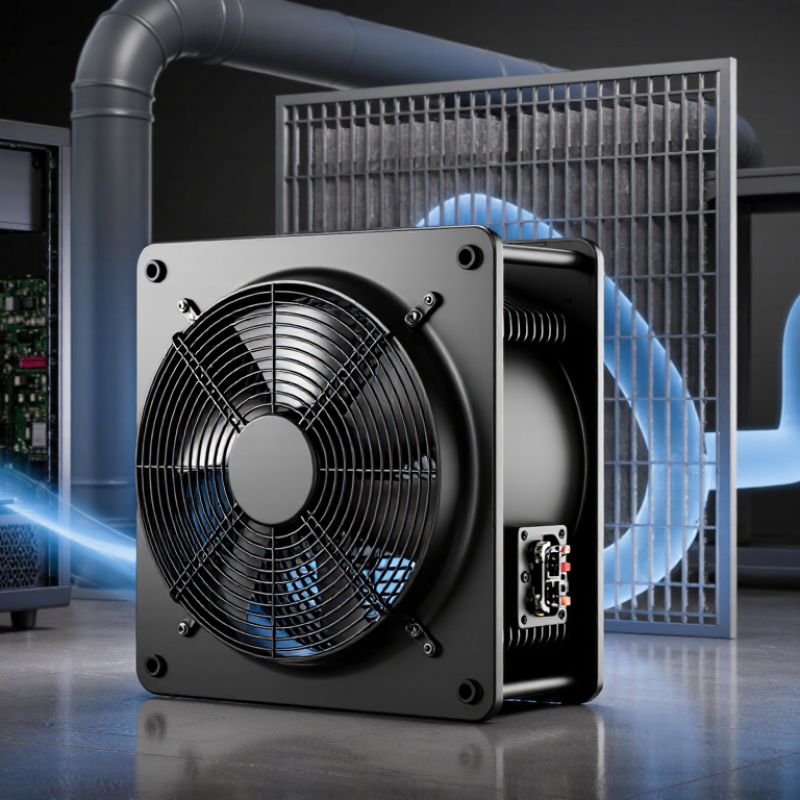
A DC blower fan moves air through a compact, directed outlet. Unlike an axial fan, it uses a rotating impeller inside a shaped housing. The impeller accelerates air outward, while the housing guides it toward the outlet. This design can produce useful static pressure in narrow ducts, vents, and electronic enclosures.
Not just airflow.
The operating point matters. A fan may provide high airflow in open air but perform poorly against resistance. Read its pressure-flow curve before choosing one. Compare required airflow, static pressure, voltage, current, and speed range.
PWM control can adjust speed efficiently, but the controller must match the motor’s electrical requirements. Low voltage can reduce performance, while excessive voltage may create heat or permanent damage.
Practical testing reveals details that specifications miss.
Mount the blower as it will operate, then check outlet airflow and surface temperature. A clogged filter, sharp duct bend, or small grille can increase resistance quickly. Listen for rattling or tonal noise. These sounds may indicate imbalance, loose mounting, or bearing wear.
Heat is important. Measure motor current during normal operation, not only during startup. I have sometimes trusted a generous airflow rating too quickly. That was a mistake.
Clearance around the inlet, secure mounting, and clean air paths often improve real performance more than a higher rated speed. Review the installation twice. Small assumptions can become large cooling problems.
Define the Airflow and Pressure Requirements
Choosing a DC blower fan starts with defining airflow and pressure, not with the fan’s physical size. Airflow describes the required volume, usually in cubic feet per minute (CFM) or cubic metres per hour. Pressure describes the resistance the fan must overcome, measured in pascals (Pa). A compact enclosure may need 80 CFM, but a dense filter, narrow grille, and long duct can demand more than 300 Pa.
Measure the real system path. Include the filter, heat sink, bends, outlet grille, and cable obstructions. Do not rely only on free-air airflow. The fan’s operating point occurs where its performance curve meets the system-resistance curve. AMCA Publication 210 explains standardized laboratory methods for measuring fan airflow and pressure. Its test approach helps compare results under controlled conditions, but field performance will usually be lower.
The U.S. Department of Energy’s Improving Fan System Performance: A Sourcebook for Industry reports that inefficient fan systems may offer 20–50% energy-saving opportunities. That figure is not a guarantee for every DC blower. It does show why pressure estimation matters. A fan running against excessive resistance can draw more power, create noise, and still fail to cool the target area. Check the curve at the intended voltage, temperature, and altitude. Consider dust buildup too. A clean prototype can mislead. That mistake is common. Use a pressure tap or an anemometer during testing, then revisit the specification before production.
Compare Fan Size, Speed, Voltage, and Power Options
How to Choose the Right DC Blower Fan?
Fan selection starts with the enclosure, not the catalog. Measure available space, required airflow, and static pressure before comparing models. A larger impeller can move more air at lower speed, often reducing noise. However, it may consume more space and create higher starting current. The U.S. Department of Energy reports that motor-driven systems use about 70% of industrial electricity. Even a small blower deserves careful efficiency testing.
Speed ratings can mislead. A fan listed at 5,000 RPM may lose airflow when filters or narrow vents restrict movement. Check the airflow curve at your actual pressure, not only the free-air figure. The Air Movement and Control Association recommends standardized fan testing, including airflow, pressure, and power measurements. I once selected a compact blower by RPM alone. It sounded impressive, but the real cooling result was weak.
Voltage must match the control system, such as 12 VDC or 24 VDC. Confirm the acceptable voltage range and startup behavior. Then compare watts at the expected operating point. Lower power is useful, but not if the fan cannot maintain temperature. The International Energy Agency has repeatedly identified efficient motor systems as a major energy-saving opportunity. Still, laboratory data cannot predict every dusty, hot installation. Leave room for fouling, wiring loss, and aging. Test the final assembly.
How to Choose the Right DC Blower Fan?
Compare representative fan options by size, speed, voltage, airflow, and power. Larger and faster blowers generally deliver more airflow, but they may also require higher power.
Values are representative engineering ranges for common DC blower configurations. Always confirm airflow, static pressure, voltage, speed, and power against the selected fan's datasheet.
Evaluate Noise, Efficiency, Reliability, and Installation Needs
How to Choose the Right DC Blower Fan?
Evaluate Noise, Efficiency, Reliability, and Installation Needs
A DC blower fan should match the system’s real airflow and pressure demands. Check the performance curve, not only the advertised airflow rating. A fan may move 80 CFM in free air but deliver far less through a narrow vent. Measure the available space, inlet direction, outlet position, and mounting-hole pattern before ordering. Small errors can create vibration, blocked airflow, or difficult maintenance.
Noise deserves practical testing. Review the sound rating, but remember that installation surfaces can amplify motor hum. A rubber isolator may reduce rattling against a thin metal panel. For offices or sleeping areas, compare dBA values at the same distance and operating speed. Lower speed usually saves power, although insufficient airflow can increase equipment temperature. That trade-off is easy to miss.
Efficiency depends on the motor, control method, and operating point. PWM control can adjust cooling more precisely than constant full-speed operation. Check voltage tolerance, startup current, connector type, and controller compatibility. Reliability requires more than a strong bearing description. Examine expected service life, operating temperature, dust protection, and protection against stalled rotors. I once focused too heavily on airflow and overlooked cable clearance during installation. The fan worked, but servicing it became awkward. Leave room for cleaning and replacement. Test the installed fan under normal load, because bench results rarely tell the whole story.
How to Choose the Right DC Blower Fan? — Evaluate Noise, Efficiency, Reliability, and Installation Needs
Typical engineering reference ranges for selecting a brushless DC centrifugal blower fan by application requirement.
| Application Profile |
Typical Fan Size |
Airflow Range |
Static Pressure |
Typical Noise |
Input Power |
Expected Service Life |
Installation and Selection Notes |
| Quiet Consumer Electronics |
50–75 mm impeller diameter
15–20 mm thickness |
5–20 CFM
(8.5–34 m³/h) |
30–120 Pa |
24–36 dBA
at 1 m |
1.5–5 W |
30,000–50,000 hours
at 25°C |
Choose a PWM-controlled model with balanced impeller blades and rubber isolation mounts. Suitable for compact control panels, network devices, and small power supplies. |
| General Enclosure Cooling |
75–97 mm impeller diameter
20–30 mm thickness |
20–60 CFM
(34–102 m³/h) |
80–250 Pa |
30–46 dBA
at 1 m |
3–10 W |
40,000–60,000 hours
at 25°C |
Use a ball-bearing design when the fan operates continuously or in a warm cabinet. Confirm that the enclosure inlet and outlet areas are large enough to avoid excessive pressure loss. |
| High-Pressure Filtered Airflow |
80–120 mm impeller diameter
25–40 mm thickness |
35–90 CFM
(60–153 m³/h) |
250–700 Pa |
42–60 dBA
at 1 m |
8–25 W |
40,000–70,000 hours
at 25°C |
Prioritize the pressure-flow curve rather than free-air CFM. Recommended for applications with dust filters, narrow air channels, heat sinks, or long exhaust ducts. |
| Low-Noise Instrumentation |
60–92 mm impeller diameter
15–25 mm thickness |
10–35 CFM
(17–60 m³/h) |
50–160 Pa |
22–32 dBA
at 1 m |
2–6 W |
30,000–50,000 hours
at 25°C |
Specify low-vibration operation, a tachometer output, and speed control. Avoid operating near the fan’s maximum speed if acoustic performance is critical. |
| Industrial Continuous Operation |
97–150 mm impeller diameter
25–51 mm thickness |
50–160 CFM
(85–272 m³/h) |
150–900 Pa |
40–65 dBA
at 1 m |
10–45 W |
50,000–80,000 hours
at 40°C |
Look for sealed bearings, thermal protection, locked-rotor protection, and an operating temperature range that covers the installation environment. Verify derating at elevated temperature. |
| Battery-Powered Equipment |
50–97 mm impeller diameter
15–30 mm thickness |
8–50 CFM
(14–85 m³/h) |
40–250 Pa |
25–45 dBA
at 1 m |
1–12 W |
25,000–50,000 hours
at 25°C |
Compare airflow delivered per watt and select a fan compatible with the battery voltage. A lower-speed fan may extend runtime but must still provide adequate cooling at the system’s worst-case load. |
Important: The values shown are typical non-brand reference ranges, not guaranteed specifications. Noise, airflow, pressure, power consumption, and service life vary with voltage, speed, mounting orientation, inlet restrictions, filter condition, ambient temperature, and measurement method.
Selection rule: Select the fan using the required airflow at the system’s actual static pressure, then verify noise, electrical compatibility, operating temperature, bearing type, protection features, mounting dimensions, and control interface.
Select and Verify the Best DC Blower Fan for Your Application
Selecting the right DC blower fan starts with the application, not the catalog photo. Define the required airflow, static pressure, voltage, and available space. A narrow air passage may need stronger pressure than a wide open grille. Check the operating temperature too. Heat changes motor performance and can shorten service life.
I usually compare the fan curve with the system resistance curve. The working point should sit near the required airflow, not at the maximum value printed on the label. Verify current draw during startup, especially when the power supply is small. Confirm the connector, speed-control method, and rotation direction. PWM control can improve adjustment, but only when the input signal matches the fan specification. Listen for vibration at several speeds. A quiet sample may become noisy after installation.
Do not rely on airflow numbers alone.
Mount the blower in its real enclosure and measure outlet airflow, pressure, sound, and surface temperature. An anemometer and pressure gauge provide useful evidence, while a simple thermal test reveals weak cooling paths. I have seen a suitable fan fail because the inlet was partly blocked. That mistake is easy to miss. Review tolerance, dust exposure, expected operating hours, and replacement access before approval. If test results differ from the datasheet, investigate the setup instead of forcing the numbers to agree.