

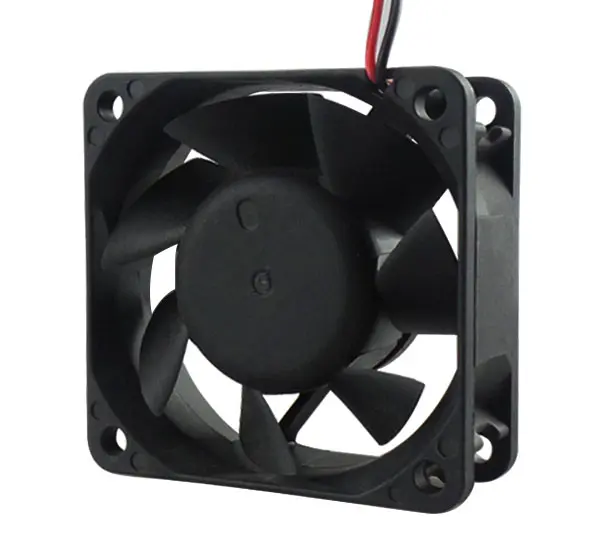

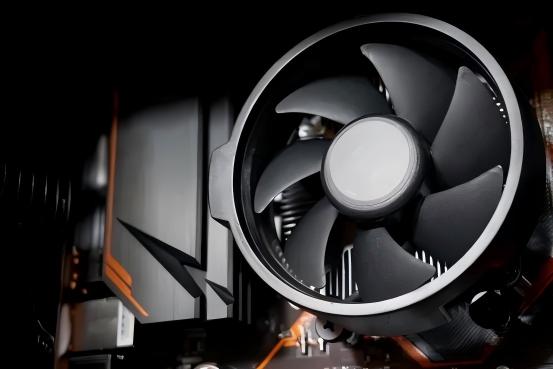
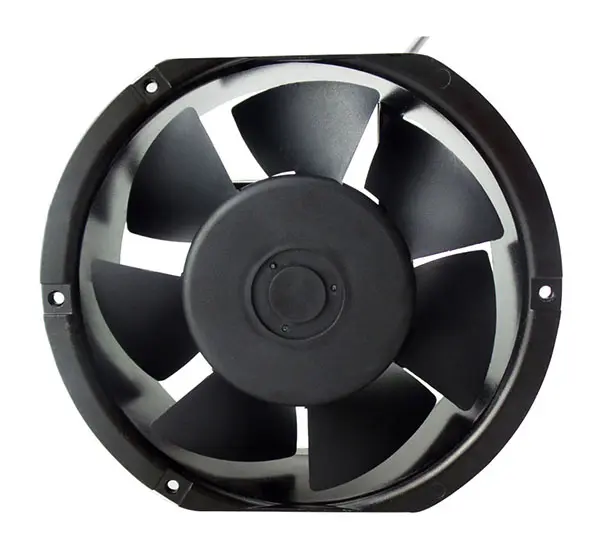
Why does the noise level of a cooling fan increase as its rotational speed rises?
1. Enhanced Airflow Turbulence: When the fan blades rotate, they interact with the air to generate an airflow. As the rotational speed (RPM) increases, the velocity of the airflow accelerates, leading to a more pronounced turbulent effect. Turbulence refers to high-frequency and irregular air movements that produce significant stray noise. Specifically, as the rotational speed increases, the intensity of the airflow rises, resulting in greater sound wave energy and consequently louder noise levels.
2. Mechanical vibration increases
Under high-speed operation, the bearings, motor, and structural components of the Fan are subjected to increased mechanical stress. Even a slight imbalance can lead to amplified deviations during rotation, thereby causing intensified mechanical vibrations and generating additional structural noise. This issue is particularly pronounced in aged or inadequately lubricated fans, where vibration and noise problems become significantly more severe.
3. The mathematical relationship governing the increase in sound pressure level
The variation in sound pressure level (SPL) can be described by an approximate formula:
SPL2=SPL1+50×log10(N2N1)\text{SPL}_2 = \text{SPL}_1 + 50 \times \log_{10}\left( \frac{N_2}{N_1} \right)SPL2=SPL1+50×log10(N1N2)
Among them:
N1 and N2 represent the initial and adjusted rotational speeds of the fan, respectively. For instance, if the rotational speed is doubled, the sound pressure level will increase by approximately 15 dB(A). Perceptually, an increase of 15 dB(A) corresponds to the perceived volume being approximately three times louder.
4. As the rotational speed increases,
The high-frequency noise component becomes more prominent. The frequency of the noise generated by the fan rises accordingly, with more energy concentrated in the high-frequency range (e.g., 2 kHz to 8 kHz). This portion of the sound is more readily detected by the human ear, thereby making the noise perceptibly sharper and more noticeable.
We recommend the following:
- Establishing a reasonable balance between rotational speed and air volume;
- Implementing PWM intelligent speed regulation technology;
- Prioritizing fans with low-noise design features;
- Scheduling regular maintenance to prevent noise increases caused by mechanical issues.