

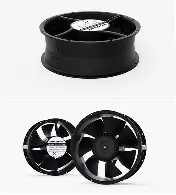
Why do 3D printers need to be equipped with a dual-fan system?
First Fan: Nozzle Cooling Fan — The Solution to the "Clogged Nozzle" Issue
The primary function of the nozzle cooling fan is to ensure uninterrupted material flow through the print head. It directs a focused airflow to a critical region known as the throat—the junction between the nozzle body and the filament feed tube. Its operational principle can be summarized as "thermal regulation to prevent backflow."
During printing, the nozzle must maintain a high temperature ranging from 200°C to 260°C, depending on the type of filament used, to achieve complete melting and consistent extrusion. In contrast, the filament within the feed tube only requires partial softening prior to entering the nozzle. If excessive heat propagates into the throat area, the filament may prematurely melt and lose its structural integrity. Under the combined influence of the drive gear's feeding force and gravitational pull, this softened material can flow backward and accumulate within the throat, ultimately obstructing the filament path—a condition commonly referred to as "nozzle clogging," frequently encountered by novice users.
By continuously delivering ambient-temperature air, the nozzle cooling fan stabilizes the throat temperature within an optimal range of 50°C to 80°C. This prevents premature solidification due to overcooling while simultaneously inhibiting upward heat conduction that could trigger reverse material flow. Therefore, this component serves as a fundamental mechanism for ensuring reliable and stable filament delivery throughout the printing process.
Second Fan: Print Cooling Fan — The Inhibitor of Dimensional Deformation
The primary function of the print cooling fan is to ensure dimensional accuracy during model formation. It directs a focused airflow toward the newly extruded filament layer immediately beneath the nozzle, with its core role defined as "accelerating solidification and enhancing interlayer adhesion."
Using the widely adopted PLA filament as an example, the material exits the nozzle at approximately 200°C in a molten state and must be rapidly cooled below 60°C within one to two seconds to achieve stable shape retention. Insufficient cooling can lead to several defects: the weight of overlying layers may deform the still-soft underlying layers, resulting in "interlayer sagging." Additionally, differential cooling rates between the faster-cooling edges and the slower-cooling center create thermal gradients, which induce internal stresses and cause shrinkage-related distortions such as "warping" or "cracking." For instance, upward curling at the corners of a printed phone case is a classic manifestation of inadequate part cooling.
The print cooling fan is engineered with precisely calibrated airflow velocity and directional orientation. This design ensures rapid thermal dissipation for prompt solidification while preventing excessive cooling that could compromise interlayer bonding strength. In models featuring complex geometries—such as curved surfaces or cantilevered structures—the fan’s role becomes particularly critical. It enables the material to maintain structural integrity during unsupported overhangs by facilitating immediate shape setting, thereby minimizing deformation and ensuring reliable print outcomes.
Dual-Fan Collaboration: A Synergistic Approach to Enhanced Print Reliability
Although the two cooling fans operate independently in function, they collectively establish a synergistic closed-loop system that ensures "uninterrupted material flow at the front end and dimensional accuracy at the rear." This cooperative mechanism is demonstrated across three key dimensions:
1. Thermal Zoning Control
The nozzle cooling fan maintains a low-temperature environment in the throat region, ensuring consistent filament feeding by preventing premature softening. Meanwhile, the part cooling fan targets the freshly deposited, high-temperature material layer immediately beneath the nozzle, accelerating solidification. Together, they establish a precisely controlled thermal gradient—characterized by high-temperature melting at the nozzle tip and rapid cooling in the surrounding build area—effectively meeting the distinct thermal requirements of the fused deposition modeling (FDM) process.
2. Enhanced Printing Efficiency
When only the nozzle cooling fan is active, insufficient interlayer cooling prolongs solidification time, necessitating reduced print speeds to allow lower layers to stabilize, thereby decreasing overall throughput. Conversely, reliance solely on the part cooling fan may lead to inadequate throat cooling, increasing the risk of heat creep, filament backflow, and nozzle clogging—resulting in frequent interruptions for maintenance. With both fans operating in tandem, the system enables sustained high-speed printing while maintaining process stability, significantly reducing failure rates and improving both print success probability and operational efficiency.
3. Expanded Material Compatibility
For engineering-grade thermoplastics such as ABS, which are highly sensitive to cooling rates and prone to warping or delamination due to thermal contraction, the dual-fan system offers superior adaptability. By independently adjusting the airflow intensity of each fan—supported on select advanced models—the system can simultaneously optimize anti-clogging performance at the nozzle and minimize deformation in the printed part. In contrast, single-fan configurations lack the flexibility to balance these competing thermal demands across diverse materials, limiting their applicability. Consequently, the dual-fan design substantially broadens the printer’s compatibility with a wide range of filament types, supporting greater versatility in material selection and application scope.
Misconception Clarification: Not "One More for Redundancy," but "One Less Leads to Failure"
Some novice users, in an effort to simplify their equipment setup, attempt to remove one of the cooling fans. However, the outcome is typically counterproductive. If the nozzle cooling fan is removed, clogging commonly occurs within the first 10 minutes of printing. If the part cooling fan is omitted, small-scale prints may still achieve basic shape retention, but larger models will almost certainly exhibit edge warping. The underlying cause lies in the fundamental thermal dynamics of the fused deposition modeling (FDM) process—specifically, the cycle of "material melting and rapid solidification." In this process, both cooling functions represent non-negotiable thermal management requirements: without the nozzle cooling fan, filament cannot be reliably fed due to heat creep and premature softening; without the part cooling fan, deposited layers fail to solidify promptly, compromising dimensional stability and structural integrity. These two systems are functionally complementary and mutually indispensable.
The dual-fan configuration employed in modern mainstream 3D printers has been established through extensive empirical testing and engineering validation as the optimal thermal control strategy. For hobbyists and DIY enthusiasts, a clear understanding of the distinct roles played by each fan not only helps prevent print failures caused by inadequate cooling but also enables more precise wind speed calibration during operation—for instance, applying high airflow when printing PLA to enhance layer solidification, or reducing airflow to medium levels when processing ABS to minimize internal stress and interlayer delamination. This knowledge ultimately contributes to significantly improved print success rates and higher-quality output.
Shenzhen Fuqingda Electronic Technology Co., Ltd. has over two decades of comprehensive experience in the research, development, and manufacturing of cooling fans. The company offers a full range of product models designed to meet diverse application requirements across multiple industries. Backed by a robust quality management system and a professional R&D team, Fukeding is committed to delivering high-performance, reliable thermal management solutions tailored to customer needs. For inquiries regarding cooling fan specifications, customization options, or technical support, please do not hesitate to contact us.