

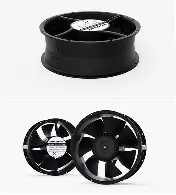
Which type of fan is more suitable for electric vehicle charging stations?
1, Is the AC Fan still adequate for current application requirements?
In the early stage of development, AC fans had certain "Rationality", mainly reflected in the following aspects:
- The supply chain was mature, procurement was convenient, and the delivery cycle was stable.
- The power supply adaptation scheme was simple, and the system integration difficulty was low.
- The unit cost was low, and there was a significant initial purchase price advantage.
- Engineering technicians were familiar with its technical characteristics, and the design and maintenance threshold was low.
However, most of the aforementioned "advantages" are based on a short-term or initial application perspective and are difficult to fully meet the current higher requirements for the long-term reliability, energy efficiency performance, and intelligent operation and maintenance of equipment.
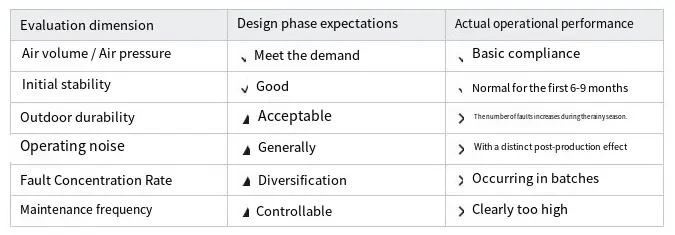
The actual performance of the early cooling solutions
2, Key turning point: All three types of problems emerged simultaneously
As the installation volume increased, systemic risks began to emerge.
1️⃣ The failure pattern is "region + seasonal" 📍🌧
The failure rate is significantly higher in the humid southern regions.
Fan malfunctions occur mainly during the rainy season and the plum rain season.
Multiple devices have the same problem in a similar time period.
➡️ Clearly indicates: Insufficient environmental adaptability
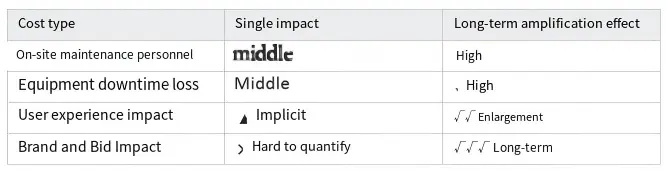
2️⃣ Maintenance costs are underestimated 💸
The cost of replacing a single fan is not high
However, the cost of on-site manual work × downtime loss × user complaints has been seriously underestimated
3️⃣ Energy efficiency indicators are gradually becoming "hard constraints" ⚡
As policies and customer requirements change:
✔ The power consumption of the charging station itself has been included in the assessment.
✔ The energy consumption of the auxiliary system is no longer "negligible".
✔ The power consumption of the AC fan becomes significantly disadvantageous during long-term operation.
3, Internal discussion: Where exactly is the root cause of the problem? 🧠
After multiple rounds of discussions between the technical team and the management, a consensus was gradually reached:
The problem is not that the AC fan is of poor quality;
Rather, it lies in the design logic of the AC fan, which does not match the outdoor EV charging station scenario.
In other words, this is an upgrade in the application scenario, but the solution has not been upgraded.
4, Alternative solution assessment: Not just "switching brands"🔄
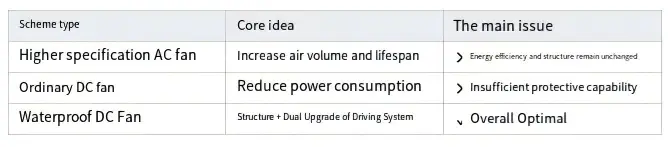
When seeking solutions, it is important to consider that simply "changing the AC fan brand" is not sufficient. Instead, we need to re-examine the fundamental logic of the cooling system.
Three alternative options
➡️ The conclusion gradually becomes clear:
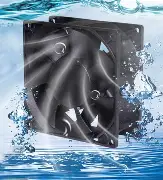
The true solution is the waterproof DC cooling fan.
Comparison of key indicators before and after the replacement
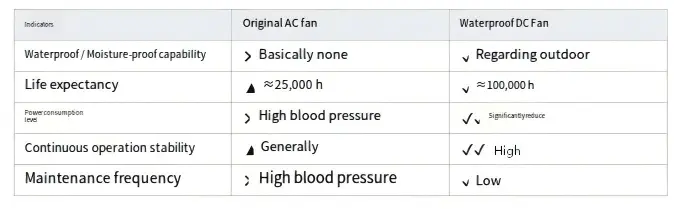
5, The systematic changes after the replacement: Not just "fans are more durable 📈"
After completing the scheme switch, the manufacturer observed a series of chain reactions:
✔ The heat dissipation alarm and overheating incidents have significantly decreased.
✔ The customer complaint rate has also dropped.
✔ The pressure on the operation team has noticeably reduced.
✔ The product becomes more persuasive in the bidding and project evaluation processes.
The replacement of the fan has brought about system-level benefits.
From the above case, it can be seen that as the requirements for energy efficiency, reliability and environmental adaptability of charging facilities continue to increase, the adoption of high-performance DC Cooling Fans has become an inevitable trend for the upgrade of charging station cooling systems.Shenzhen Fuqingda Electronic Technology Co., Ltd., with over 20 years of professional manufacturing experience in cooling technology, can provide customized and highly reliable cooling solutions for various outdoor high-load operation scenarios. It is a trustworthy partner and we welcome inquiries for cooperation.