

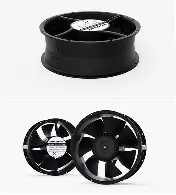
Which method results in less noise: increasing the number of cooling fans or enhancing their operational speed?
The main sources of cooling fan noise can be categorized as follows:
- Aerodynamic noise: This refers to the eddy noise produced when Fan blades rotate at high speeds.
- Mechanical noise: This originates from the operational noise of the motor and friction in the bearings.
- Resonance noise: This is caused by improper fan installation or vibrations within the chassis structure.
1. Enhance the Fan Speed
Based on the fan noise calculation formula:
y = SPL₁ + 50 × log(N₂/N₁)
Where:
- SPL₁ represents the initial noise level (dB(A)),
- N₁ and N₂ denote the original and new speeds, respectively.
For instance, if a fan with an initial noise level of 40 dB(A) is operated at twice its original speed, the noise will increase by approximately 15 dB(A), resulting in a total noise level of 55 dB(A).
Advantages:
- The air volume can be significantly increased, thereby enhancing heat dissipation performance.
- Implementation only requires replacing the fan, without requiring additional installation space.
Disadvantages:
- Noise levels rise substantially, potentially degrading user experience.
- High-speed operation accelerates fan wear, reducing its lifespan.
- Turbulence may occur within the air duct, negatively impacting heat dissipation efficiency.
2. Impact of Increasing the Number of Fans on Noise Levels
When multiple fans operate simultaneously, the total noise level can be calculated using the following formula:
y = 10 × log(10^(SPL₁/10) + 10^(SPL₂/10))
For instance, two fans running at 40 dB(A) would result in a total noise level of approximately 43 dB(A), an increase of only 3 dB(A). This increment is significantly lower than the noise increase caused by raising the speed of a single fan.
Advantages:
- Provides a higher air volume with minimal noise increase.
- Low-speed operation reduces noise levels and extends the lifespan of the fans.
- The air duct achieves better balance, enhancing heat dissipation efficiency and stability.
Disadvantages:
- Requires additional installation space.
- May lead to increased device power consumption.
3. If the objective is to minimize noise, increasing the number of fans is preferable to increasing the speed of a single fan. If space is constrained and noise levels are not a primary concern, enhancing the fan speed may represent a more practical solution.
4. Conclusion
In the cooling scheme, increasing the number of fans is generally quieter than increasing the speed, as the noise increase follows a logarithmic pattern. A higher speed results in a more significant rise in noise levels. If the device permits an increase in the number of fans while maintaining a lower speed, efficient heat dissipation can be achieved with reduced noise. Selecting the appropriate heat dissipation strategy involves finding an optimal balance among heat dissipation performance, noise level, and equipment space constraints.