

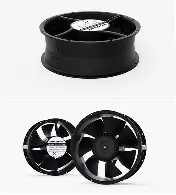
What is the rationale behind establishing a minimum and maximum operating temperature limit for the cooling fan?
优化后文本:
1. The core component of the thermally sensitive cooling fan in the motor is the motor itself, where the coil and magnet are highly sensitive to temperature variations. At low temperatures, the lubricant within the motor may become viscous, increasing starting resistance and potentially causing difficulties in motor startup or leading to overloading. At high temperatures, the insulation material of the motor may degrade, thereby increasing the risk of short circuits. For instance, at -10°C, the viscosity of the lubricant increases by 30%, resulting in a higher starting current.
2. Thermal expansion and contraction of materials: Fan blades and frames are typically constructed from plastic, metal, or other synthetic materials. These materials expand or contract in response to temperature changes. Extremely low temperatures can cause materials to become brittle and prone to cracking. Extremely high temperatures may lead to material deformation, affecting the balance and efficiency of the fan. For example, the hardness of aluminum alloys increases by approximately 15% at -40°C compared to 20°C, whereas deformation may occur at 100°C.
3. The viscosity of the lubricating oil in the Fan Bearing varies with temperature. At low temperatures, the lubricant may become excessively viscous, increasing bearing friction and reducing fan speed. At high temperatures, the lubricating oil may become too thin, losing its lubrication effectiveness and accelerating bearing wear. Typically, at -20°C, the viscosity of the lubricating oil is twice that at 20°C.
4. Air Density and Flow Efficiency: Fans dissipate heat by moving air. As the temperature decreases, the density of the air increases, which can enhance airflow but may reduce the fan's heat dissipation efficiency due to increased resistance. Conversely, in low-temperature environments, fans may not provide adequate cooling due to reduced airflow requirements. At high temperatures, the heat capacity of the air increases, requiring fans to expend more energy to move the same volume of hot air. For instance, air is approximately 8% less dense at 0°C compared to 40°C.
5. Tolerance of Circuits and Electronic Components: Cooling fans incorporate circuits and electronic components with specific temperature tolerance ranges. Low temperatures may slow down the response speed of circuit components, while high temperatures can degrade component performance or even cause damage. For example, the response time of certain semiconductor components is approximately 30% slower at -40°C than at 25°C.