




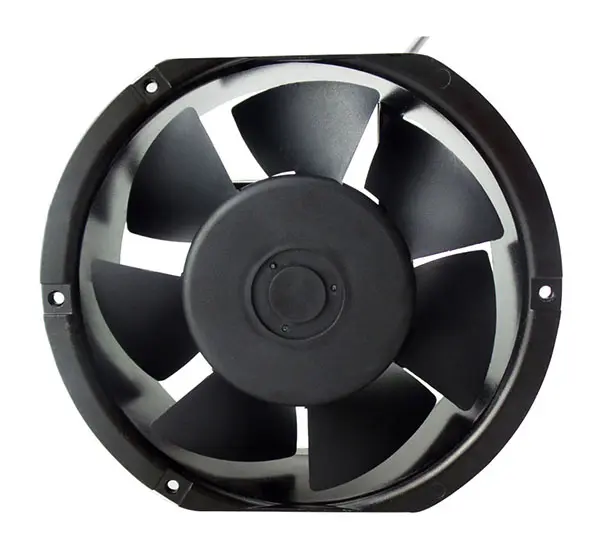
What are the speed regulation methods for cooling fans, and what are the respective advantages and disadvantages of each method?
1, Fixed-speed(constant-speed) operation -- characterized by simplicity and reliability, yet limited in flexibility.
Fixed-speed Fans are engineered to operate consistently at a single speed irrespective of the device's temperature.
**Advantages:**
✅ Possesses a straightforward design with minimal complexity, resulting in lower manufacturing costs.
✅ Exhibits high reliability due to the absence of additional control circuits, reducing potential failure points.
✅ Ideal for applications involving constant loads, such as household fans or industrial cooling systems.
**Disadvantages:**
❌ Lacks the ability to adapt intelligently to variations in device temperature, limiting energy efficiency.
❌ May lead to unnecessary power consumption or excessive noise under certain conditions.
**Application Scenarios:**
Older personal computer fans, power supply units, and residential fans.
2, Voltage Control (DC Speed Regulation) - This method is characterized by ease of use and moderate accuracy. The fan speed is controlled by adjusting the operating voltage of the fan, typically ranging from 5V to 12V DC.
Advantages:
✅ Simple construction and straightforward implementation (e.g., via adjustable resistors or voltage regulators).
✅ Suitable for low-power applications.
✅ Cost-effective, making it ideal for large-scale deployments.
Disadvantages:
❌ At lower voltages, the fan may fail to start.
❌ The adjustment range is limited, potentially leading to unstable operation of the fan under certain conditions.
Application Scenarios:
This method is commonly used in desktop power supply fans and small embedded devices.
3, Pulse Width Modulation (PWM) speed regulation is a highly accurate and efficient method widely employed in various applications. PWM regulates fan speed by controlling the duty cycle, which is the ratio of "on" time to the total cycle time of the voltage signal. For instance, when the Duty Cycle of the PWM signal is set to 50%, the effective power supplied to the fan corresponds to half of its rated power, thereby reducing the rotational speed.
Advantages:
✅ High efficiency and energy conservation without altering the supply voltage.
✅ Precise control with a broad adjustable range.
✅ Low noise operation, making it suitable for devices requiring silent performance.
✅ Stable startup characteristics, enabling reliable operation even at low speeds.
Disadvantages:
❌ Requires a dedicated PWM controller, such as a motherboard or external module.
❌ May generate high-frequency electromagnetic interference (EMI), though this can be mitigated through the use of filtering circuits.
Application Scenarios:
PWM speed regulation is commonly utilized in modern PC fans (e.g., Cpu Fans and chassis fans), server cooling systems, and industrial equipment.
4, Thermal Control -- Intelligent Adjustment, Quiet Operation, and Energy Efficiency
The temperature control speed regulation system employs a high-precision temperature sensor (such as an NTC thermistor or digital temperature control chip) to automatically adjust the fan speed based on real-time temperature changes. Specifically, when the device's temperature increases, the fan accelerates to dissipate heat more effectively. Conversely, when the temperature decreases, the fan slows down or stops entirely to conserve energy.
Advantages:
✅ Fully automatic adjustment without manual intervention
✅ Provides intelligent quiet operation with minimal fan noise at low load conditions
✅ Promotes energy efficiency and environmental protection by increasing fan speed only under high-temperature conditions
Cons:
❌ Potential delay in temperature sensor response
❌ Requires an additional temperature detection circuit, which may increase overall costs
❌ Complex temperature control systems might necessitate software support for optimal performance
Application Scenarios:
This technology is widely applicable in laptops, smart home appliances (e.g., air conditioners, refrigerators), and data center servers.
5, Intelligent Fan (IoT Remote Control) -- Remote Adjustment and Precise Management
With the advancement of the Internet of Things (IoT), intelligent fans are progressively becoming a benchmark for high-end devices. These Smart Fans can establish connections with servers or cloud platforms through wireless communication protocols such as Wi-Fi, Zigbee, and Bluetooth, enabling remote monitoring and regulation.
**Advantages:**
✅ Remote Monitoring: Allows real-time adjustment of fan status from any location.
✅ Intelligent Speed Control: Integrates environmental sensors to automatically optimize fan performance based on surrounding conditions.
✅ Customization: Suitable for advanced industrial applications and smart home systems.
**Disadvantages:**
❌ Higher Cost: Smart fans are more expensive compared to traditional models and rely on stable network connectivity.
❌ Software Dependency: Requires additional software or dedicated APP support for full functionality.
❌ Security Concerns: Potential vulnerability to cyberattacks necessitates robust security measures.
**Application Scenarios:**
Smart Home Systems (e.g., intelligent air conditioners, fans), Data Centers, and Remote Monitoring Solutions.
In conclusion,
✅ If you require simple and reliable fan speed regulation, fixed-speed or voltage regulation can suffice.
✅ If more precise control is desired, PWM (Pulse Width Modulation) represents the optimal solution.
✅ For those seeking automated intelligence, temperature-controlled fans or IoT-enabled fans present a promising future.
Regardless of the method chosen, appropriate speed regulation not only enhances heat dissipation efficiency but also reduces noise and energy consumption, thereby ensuring more stable and quieter equipment operation.