

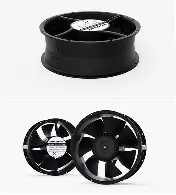
Is a more powerful cooling fan associated with a superior cooling effect?
In this context, there exists a fundamental relationship between air volume and heat dissipation efficiency.
Air volume is a critical parameter of heat dissipation Fans, representing the volume of air generated by the fan per unit time. It is typically measured in cubic meters per hour (m³/h) or cubic feet per minute (CFM). Under ideal conditions, a greater air volume can accelerate heat transfer, thereby enhancing the heat dissipation effect.
When a cooling device, such as a radiator or heat sink, becomes heated, it transfers thermal energy to the airflow generated by the fan. A larger air volume can absorb more heat and subsequently carry it away, facilitating a more rapid heat exchange process. However, excessive air volume may introduce issues such as increased noise, non-uniform heat dissipation, and higher power consumption.
Therefore, when selecting a Cooling Fan, it is essential to consider factors such as the heat dissipation requirements of the equipment, spatial constraints, noise levels, and energy consumption to identify an appropriate fan model that ensures stable and efficient operation.