

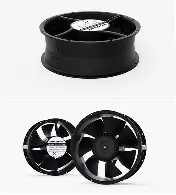
How to assess whether a cooling fan meets technical standards
The compliance of a Cooling Fan with applicable standards should be assessed based on the extent to which its performance parameters meet actual operational requirements. Key performance indicators include air flow rate, static pressure, cooling efficiency, noise level, and power consumption—these five metrics serve as the primary criteria for evaluating fan performance. Different application scenarios prioritize these indicators differently: industrial equipment typically emphasizes high static pressure and operational stability, whereas gaming and high-performance computing systems place greater importance on high air flow rate and low noise operation. Consequently, evaluation procedures should incorporate targeted testing methods tailored to specific application needs.
1, Air Volume Test: A Fundamental Indicator of Heat Dissipation Capability
Air volume refers to the volume of air delivered by a fan per unit time, typically measured in cubic feet per minute (CFM) or cubic meters per hour (m³/h). It represents a key determinant of thermal performance. Insufficient air volume can result in heat accumulation, leading to frequent thermal throttling and degradation of equipment performance, thereby compromising operational stability and reliability.
Standardized Testing Method: The measurement is conducted using a wind tunnel test bench, where the fan is securely mounted within a standardized wind tunnel setup. Airflow sensors are employed to accurately capture the volumetric flow rate under controlled conditions. The measured value is then compared with the rated air volume specified in the product datasheet. Compliance is generally confirmed if the deviation between the measured and nominal values remains within ±5%. For instance, a fan labeled as 80 CFM should exhibit a measured airflow between 76 and 84 CFM to meet technical specifications.
Practical Alternative Approach: In resource-constrained environments lacking specialized equipment, a simplified test setup may serve as a preliminary evaluation method. This involves constructing an enclosed cardboard chamber with an aperture on one side sized to fit the fan, and a small opening on the opposite side for inserting an anemometer. Upon fan activation, the outlet air velocity is recorded and multiplied by the effective cross-sectional area of the fan, followed by multiplication by 60 to convert the result into airflow per minute (i.e., Air Volume ≈ Velocity × Area × 60), yielding an estimate in m³/h or CFM. While this approach lacks the precision of laboratory-grade testing, it provides a practical means of detecting significant discrepancies between claimed and actual performance, enabling initial screening and risk mitigation.
2. Wind Pressure Test: A Critical Indicator of Airflow Penetration in Complex Duct Systems
Wind pressure denotes a fan's ability to overcome airflow resistance within confined or obstructed air passages, typically measured in millimeters of water column (mmH₂O) or pascals (Pa). This parameter is particularly critical for high-density thermal environments such as servers and graphics cards, which feature closely spaced heat dissipation fins. Insufficient wind pressure results in inadequate airflow penetration through fin gaps, severely compromising cooling effectiveness and leading to localized hotspots.
Standardized Testing Method: The test is conducted using a dedicated "wind pressure testing apparatus," where an adjustable flow resistance baffle is installed at the fan’s outlet to simulate real-world duct impedance. A calibrated pressure sensor measures the static pressure generated under varying resistance levels. Compliance is verified when the fan achieves at least 90% of its rated wind pressure at the specified nominal airflow. For instance, a fan labeled with a wind pressure of 3.5 mmH₂O must demonstrate a measured value no lower than 3.15 mmH₂O to meet technical specifications.
Practical Alternative Approach: In the absence of laboratory equipment, a qualitative assessment can be performed using a lightweight foam panel (approximately 5 mm thick) mounted vertically. The fan is positioned to blow directly against the panel, and the deflection height is observed. Under consistent setup conditions, a greater displacement indicates higher effective wind pressure. Additionally, if noticeable airflow attenuation occurs when the fan operates against a low-resistance mesh filter, this may indicate insufficient static pressure delivery. While this method does not yield precise quantitative data, it serves as a practical preliminary screening tool for identifying underperforming units.
3. Heat dissipation efficiency: Direct verification of the final effect
The "paper data" of air volume and air pressure needs to be converted into actual heat dissipation effects, which is the ultimate criterion for determining whether the fan meets the standard.
Test plan: Taking the computer CPU as an example, under the same environmental temperature (25℃) and the same heat sink (excluding other variables), conduct thermal testing (such as running Prime95 for 30 minutes) using the tested fan and the "benchmark fan" (known to be compliant) respectively. Record the stable temperature using CPU temperature monitoring software (such as HWInfo). If the temperature of the tested fan differs from that of the benchmark fan by no more than 3℃, then the heat dissipation efficiency is met.
Industrial equipment scenario: By comparing the core component temperatures before and after fan replacement through the built-in temperature sensor of the equipment, if the temperature drops to the safe threshold and is consistent with the design expectation, it is considered to be compliant.
4. Noise and Power Consumption: Dual Considerations of Experience and Energy Efficiency
A qualified fan not only needs to "be able to dissipate heat", but also "be quiet and energy-efficient". Especially in home, office and gaming scenarios, noise sensitivity is high, while in industrial scenarios, there are cost requirements for power consumption.
Noise Test: In a quiet environment with no noise (noise ≤ 30dB), use a noise meter to measure the operating noise at a distance of 1 meter from the fan. Compare the "noise value" marked on the product (usually the data at a distance of 1 meter), and the actual measured value should not exceed the marked value by 2dB to be qualified. Note: The noise of the fan should be lower at low speeds, and the noise should increase uniformly at high speeds, without sharp abnormal sounds.
Power Consumption Test: Use a power meter to connect the fan's power supply (for DC fans, an adapter power supply is required), measure the actual power consumption during operation. If the error between the measured value and the marked "rated power consumption" is within ±10%, it is considered to meet the energy-saving standard. For example, a fan marked "3W", the actual measured value should be between 2.7-3.3W, which meets the requirements.
Summary: "Criteria for Judging Qualified Fans"
To determine if a cooling fan meets the standards, it requires a dual check of both performance and quality: In terms of performance, the fan's air volume, air pressure, and cooling efficiency should match the specifications, with noise and power consumption being controllable; in terms of quality, there should be no flaws in the appearance details, the operation should be stable without any abnormalities, the bearings and motor should be durable, and there should be certifications and after-sales guarantees.
Whether for personal use or enterprise procurement, it is recommended to prioritize brands with a good reputation (such as Fuqingda), and keep the test data and purchase vouchers. If you find that the product significantly deviates from the specifications, you can seek redress through the after-sales channel. Remember: A qualified fan is not "the pricier the better", but rather "matching the requirements in terms of parameters and with quality that can stand the test".