

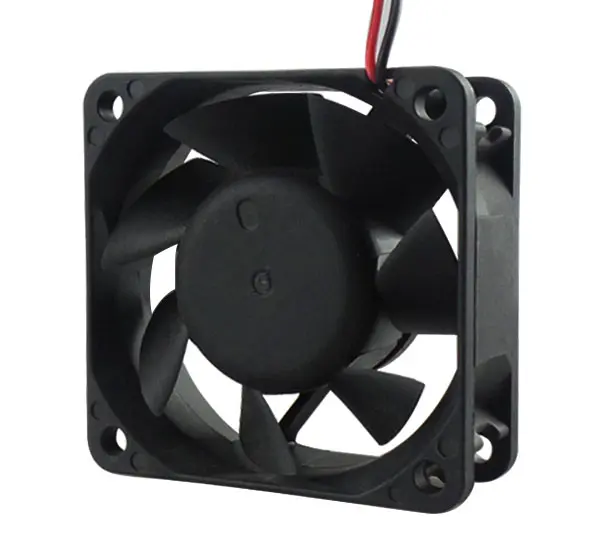

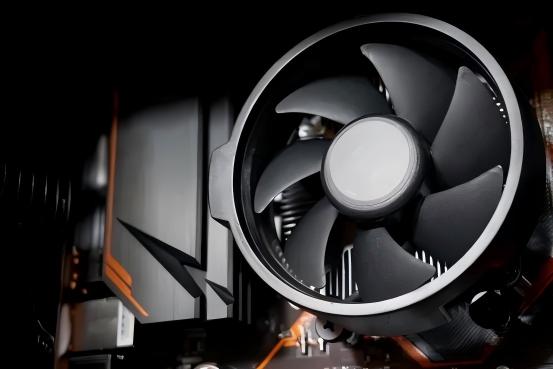
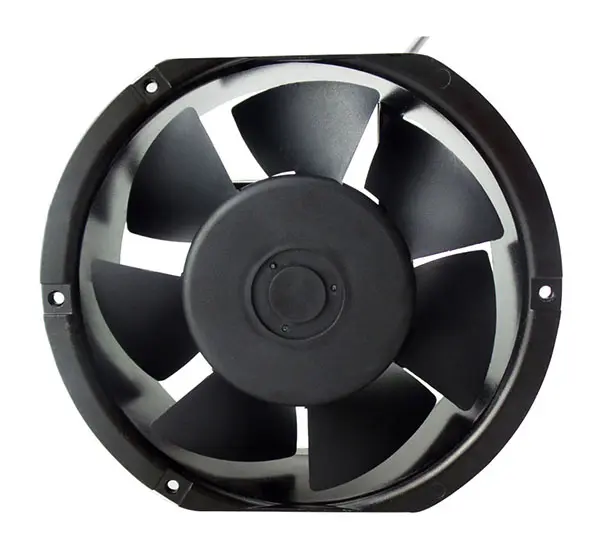
Does the geometry of the mesh influence the noise level of the cooling fan?
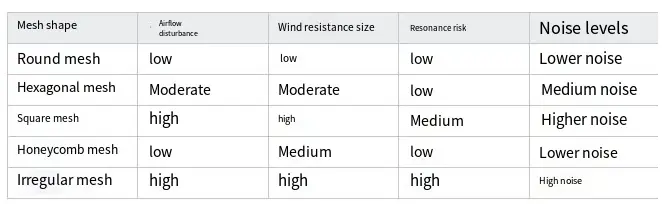
✅ How does the shape of the mesh influence Fan noise? The primary function of the fan mesh is not only to safeguard the fan blades but also to significantly impact airflow characteristics, which in turn directly influences the noise level. Various mesh designs affect several critical factors:
- Airflow Disturbance:
The geometry of the mesh determines how air flows through the fan. Sharp angles or irregular shapes may lead to increased turbulence, thereby elevating noise levels.
- Wind Resistance:
The fan must overcome the air resistance generated by the mesh. Excessive resistance can cause the fan to operate at higher speeds, consequently increasing noise.
- Resonant Noise:
Certain mesh designs may induce resonance at specific wind speeds, generating high-frequency noise
✅ 2. Round vs. square mesh: Which is quieter?
In the design of fan mesh, round mesh and square mesh are the two most common choices. Both have their own characteristics in wind resistance and airflow disturbance.
Round mesh:
✅ The airflow is smooth and the wind resistance is small
✅ is not easy to form vortex, so the resonance noise is low
✅ suitable for high wind speed fans, can reduce fan noise square mesh:
❌ high wind resistance, which may affect the air output of the fan
❌ corners are easy to cause air flow splitting, forming turbulent noise
❌ At certain rotational speeds, resonance may be formed, which increases the high-frequency noise of the fan
Comparison of Test Data for a 120mm Fan Operating at 1500 RPM

Conclusion:
The circular mesh exhibits reduced wind resistance and lower overall noise levels compared to alternative designs.
✅ 3. Hexagonal vs. cellular mesh: The secret to optimized airflow
In addition to the traditional round and square mesh, hexagonal mesh and honeycomb mesh are getting more and more attention. Both designs are widely used in many high-end cooling systems, such as server cases and industrial cooling systems.
Hexagonal mesh:
✅ High airflow fluency and moderate wind resistance
✅ Suitable for medium-high wind speed fans
✅ heat dissipation efficiency is better, but the noise is slightly higher than the circular mesh
Cellular mesh:
✅ similar to circular mesh, but with enhanced air permeability
✅ Reduces wind resistance and turbulence noise
✅ is widely used in high-performance heat dissipation systems, such as high-end electronic sports chassis and server heat dissipation solutions
Comparison of Hexagonal and Cellular Mesh Test Data for a 120mm Fan Operating at 1500 RPM

Conclusion:
The honeycomb mesh exhibits the lowest wind resistance and superior noise control performance compared to other designs.
✅ 4. How do mesh spacing and thickness affect noise?
In addition to mesh shape, mesh spacing and mesh thickness also affect fan noise.
Influencing factors:
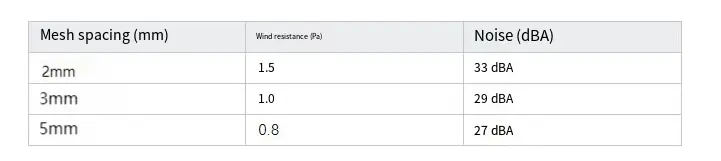
The mesh spacing is too small → the wind resistance increases and the noise increases
Moderate mesh spacing → uniform air volume, stable air flow, reduce noise
The thickness of the net cover is too thick → the wind resistance increases, the fan load increases, and the noise increasesImpact of different mesh spacing on noise (120mm fan @ 1500RPM)
Conclusion:
Appropriate mesh spacing within the range of 3 to 5 millimeters contributes to noise reduction and enhances fan efficiency.
Summary:
The effect of mesh design on fan noise
✅ Round and cellular mesh is best for reducing wind resistance and noise
✅ hexagonal mesh is second, suitable for medium to high wind speed fans
✅ Square and irregular mesh can easily cause airflow disturbance and increase noise
✅ Mesh spacing of 3-5mm is optimal to achieve a balance between air volume and noise
If you want to optimize the cooling effect of the fan while reducing noise, then choosing the right mesh shape is a key factor that cannot be ignored!