Leave Your Message

What Are the Top Cross Flow Fan Suppliers Worldwide?

Choosing the right Cross Flow Fan supplier is rarely a simple ranking exercise. Global buyers must compare airflow, pressure stability, noise levels, motor efficiency, customization, and delivery reliability. A compact fan may look impressive on a specification sheet. It can still underperform inside a narrow air curtain or electronic cooling assembly.

Fan-system researcher Dr. Eckehard W. Müller captures this concern: “A fan’s real value appears only after airflow, noise, and pressure are measured together.” That principle guides this overview of leading Cross Flow Fan suppliers worldwide. The discussion considers manufacturers serving HVAC equipment, air conditioners, heaters, refrigeration units, display systems, and industrial machinery. It also examines practical details, such as impeller balance, bearing life, motor control, temperature tolerance, and laboratory testing.

Performance is not everything.

A dependable supplier should provide clear technical drawings, repeatable production quality, responsive engineering support, and traceable test data. Certifications may help, but they do not replace application-specific validation. Buyers should request operating curves, noise measurements, electrical details, and sample units before approving large orders. Small differences in blade geometry can change sound levels and energy use. This is easy to overlook.

The supplier landscape also changes quickly. New factories emerge, regional strengths shift, and product catalogs are sometimes difficult to compare fairly. Therefore, this guide does not treat one company as universally superior. Instead, it offers a practical framework for identifying reliable Cross Flow Fan partners. Some conclusions may need revision after real-world testing. That is a weakness, perhaps, but honest evaluation begins there.
What Are the Top Cross Flow Fan Suppliers Worldwide?

Cross-Flow Fan Fundamentals: Impeller Design, Airflow, and Static Pressure

Cross-flow fans use a long, cylindrical impeller to move air across its rotating blades. Unlike axial fans, air does not travel straight through the rotor. It enters the impeller, forms an internal vortex, and exits through the outlet opening. This creates a broad, even air stream for equipment panels, air curtains, and compact cooling systems.

Impeller design strongly affects performance. Blade angle, diameter, width, and blade count influence airflow, noise, and pressure. Forward-curved blades can move useful air at moderate speeds, but excessive speed may increase turbulence and sound. Housing geometry matters too. Small clearances improve efficiency, while poor inlet alignment can create recirculation. Static pressure should be checked at the required airflow, not only under free-air conditions. A fan may look powerful on a test bench and perform poorly inside a restrictive enclosure. That mistake is common.

Tips: Compare supplier curves using the same test method and units. Check airflow, static pressure, noise, power draw, and operating temperature together. Ask for impeller balance data and endurance-test details. Inspect the outlet path in a prototype, because real ducts rarely match drawings perfectly. Do not ignore vibration. It often reveals an alignment or bearing problem before failure. A calculation can still be wrong. Measure the finished assembly, then revise the selection.

Supplier Evaluation Standards: IEC 60335, ISO 9001, CE, RoHS, and IP Ratings

When comparing top cross flow fan suppliers worldwide, compliance should come before catalogue breadth. IEC 60335 testing checks electrical safety, abnormal operation, insulation, heating, and mechanical hazards. Ask for the exact part standard, edition, laboratory scope, and test report number. A supplier claiming “IEC compliant” without evidence deserves caution. CE is a manufacturer’s declaration of conformity, not an independent quality award. RoHS documentation should identify restricted substances, supplier controls, and revision dates. These details matter when fans enter appliances sold across several markets.

ISO 9001 supports controlled design, purchasing, corrective action, and traceability. The ISO Survey 2022 recorded more than 1.2 million ISO 9001 certificates worldwide, showing its reach, but not every certificate proves strong fan engineering. Verify the certificate scope and audit status. For dusty or damp equipment, read the IP rating carefully. IP54 indicates limited dust ingress and protection against water splashes. It does not promise washdown durability. Request airflow curves, noise data, bearing-life assumptions, temperature limits, and samples from normal production.

Tips: Build a weighted supplier scorecard. Give safety evidence and traceability more weight than price. Check whether reports match the offered motor, impeller, voltage, and grille. Inspect three production samples, not one polished prototype. I have seen elegant certificates fail to answer basic questions about winding insulation. That is an uncomfortable gap. Recheck certificates directly with issuing bodies when possible, and record every revision. A supplier may pass a desk review yet struggle with vibration, noise, or batch consistency. Treat that risk as measurable, not theoretical.

Global Supplier Comparison: 20–300 mm Sizes, 60 dB(A) Noise, and Efficiency

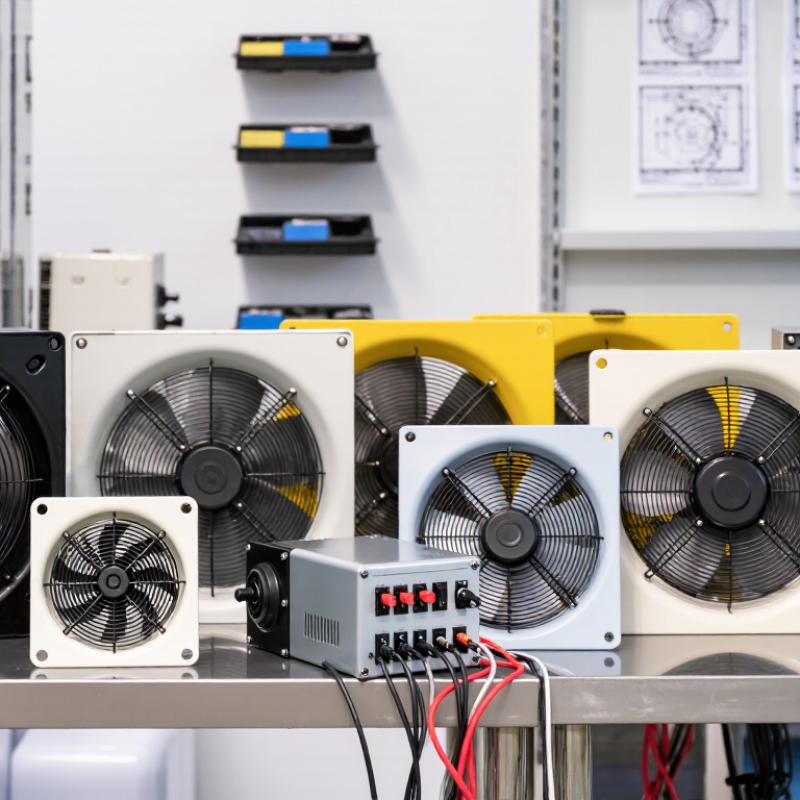
Comparing top cross flow fan suppliers requires more than checking catalogue prices. Industrial buyers should examine models from 20 to 300 mm, because housing depth, airflow path, and motor placement change performance. A compact 20 mm unit may suit control panels, while a 300 mm assembly can cool larger heating zones. Supplier drawings should show impeller diameter, operating voltage, airflow, static pressure, and bearing design.

Noise claims need careful reading. A rating near 60 dB(A) may be acceptable in machinery rooms, but measurement distance and chamber conditions can differ. Ask for test reports, not only brochure figures. Airflow should be compared at the same pressure, since free-air values can look impressive. Efficiency also needs a clear definition. Some suppliers report motor efficiency, while others describe total fan efficiency, including electronics and losses.

I have found that reliable suppliers provide samples, dimensional tolerances, lifecycle data, and responsive engineering support. They should explain how performance changes between low-speed and maximum-speed operation. Thermal testing under dust, vibration, and restricted intake conditions is useful. Not every supplier offers it. That matters. A low-cost fan may pass a short laboratory test but perform poorly after months of continuous use. Even published noise data deserves review, because real equipment often adds panels, grills, and resonance. A practical comparison should record airflow, power input, temperature rise, and sound at identical conditions before approval.

What Are the Top Cross Flow Fan Suppliers Worldwide?

Global Supplier Comparison: 20–300 mm Sizes, 60 dB(A) Noise Target, and Efficiency

This anonymous engineering benchmark summarizes representative published specification ranges for cross-flow fans by nominal impeller diameter. Noise values are measured near typical operating points, while efficiency indicates approximate motor-to-airflow performance. Actual results vary with voltage, speed, housing design, and system resistance.

Top Regional Manufacturers: Production Capacity, Lead Times, and Customization Data

Choosing top cross flow fan suppliers requires more than comparing catalog prices. Regional production data often reveals stronger differences. A mid-sized Asian manufacturer may produce 20,000 to 60,000 units monthly. European facilities commonly operate at lower volumes, often between 5,000 and 20,000 units. North American suppliers may focus on smaller batches and engineered applications. These figures are practical benchmarks, not fixed standards.

Lead times change with motor type, housing material, and order quantity. Standard aluminum or plastic assemblies may ship within three to six weeks. Custom tooling can extend delivery to eight or twelve weeks. During factory audits, buyers should check actual monthly output, not only advertised capacity. Ask for recent production schedules, inspection records, and sample dispatch dates. Paper capacity can look impressive.

Customization separates capable suppliers from simple resellers. Useful options include variable-speed motors, quiet bearings, corrosion-resistant coatings, modified impeller lengths, and tailored mounting brackets. Some manufacturers support airflow testing at several static pressures, with measured noise levels shown in decibels. Request test conditions, because “low noise” means little without distance and speed data. Regional engineering teams may shorten communication cycles, while overseas plants can offer broader tooling resources. That trade-off deserves attention. No supplier performs perfectly across price, speed, quality, and flexibility.

A pilot order of 50 to 200 units can expose fit problems before full production. Small tests matter.

Application-Based Selection: HVAC, Electronics, Appliances, and Air Curtains

What Are the Top Cross Flow Fan Suppliers Worldwide?

Choosing a cross flow fan should begin with the application, not supplier popularity. In HVAC equipment, airflow stability, low noise, and continuous operation matter most. The U.S. Department of Energy reports that HVAC systems can represent about 40% of commercial building energy use. Therefore, efficient motors and properly matched impellers deserve serious attention.

Electronics require compact fans with controlled vibration and reliable thermal performance. A small temperature rise can shorten component life. For appliances, suppliers should provide corrosion-resistant materials, balanced rotors, and repeatable airflow testing. Air curtains need strong air coverage across doors, especially in busy retail or industrial entrances. ASHRAE research links entrance design and air movement with building energy performance, but real results vary with door traffic and indoor pressure. No universal winner exists.

Tips: Compare airflow at the same static pressure, not only free-air volume. Request test data based on AMCA 210 or equivalent standards. Check sound levels at the working distance. Ask about motor protection, bearing life, and replacement availability. A cheaper fan may perform well initially, yet its noise can increase after months of dust exposure. This is often overlooked. Independent testing remains valuable, because catalog figures sometimes describe ideal conditions rather than installed performance.

What Are the Top Cross Flow Fan Suppliers Worldwide? - Application-Based Selection: HVAC, Electronics, Appliances, and Air Curtains

Application Typical Airflow Range Typical Static Pressure Typical Operating Temperature Preferred Fan and Motor Configuration Primary Selection Priorities Recommended Supplier Evidence Relevant Standards or Tests
HVAC Fan-Coil Units and Indoor Air-Handling Equipment Approximately 100–1,500 m³/h Approximately 50–300 Pa Typically 0–50°C air temperature, depending on the unit design Forward-curved cross-flow impeller; shaded-pole, PSC, or electronically commutated motor; multi-speed or variable-speed control Stable airflow at the system operating point; low sound power; balanced impeller; energy efficiency; long bearing life; easy integration with control boards Performance curves, sound-power data, vibration results, motor efficiency data, endurance-test records, and dimensional drawings ISO 5801 or AMCA 210 for airflow and pressure testing; IEC 60034 for motor-related requirements where applicable
Electronics Cooling and Compact Thermal-Management Systems Approximately 30–500 m³/h Approximately 50–300 Pa Commonly 0–60°C ambient; higher-temperature designs require application-specific validation Compact direct-drive impeller; brushless DC or electronically commutated motor; tachometer, PWM, or alarm output when required Compact envelope; high airflow-to-noise ratio; low electromagnetic interference; controlled speed; reliable restart; resistance to dust and vibration Acoustic test data, EMC test reports, life-test data, protection-rating information, locked-rotor protection details, and control-interface specifications IEC 60529 for ingress protection where applicable; CISPR 32 or relevant EMC requirements for the finished equipment
Residential and Commercial Appliances Approximately 30–600 m³/h Approximately 20–180 Pa Usually 0–70°C air temperature; appliance-specific testing may include heat, moisture, or grease exposure Cost-optimized direct-drive design; shaded-pole, PSC, or BLDC motor; integrated thermal protection; optional custom mounting brackets Low unit cost; repeatable mass production; moisture and contamination resistance; low vibration; safety protection; supply-chain continuity Production-capacity information, process-control records, incoming-material controls, safety declarations, sample approval reports, and change-management procedures IEC 60335-1 and applicable product-part standards; EMC testing according to the appliance market and product category
Air Curtains for Doors and Openings Approximately 500–3,000 m³/h per fan assembly Approximately 80–350 Pa Typically 0–50°C inlet-air temperature; heated systems require separate thermal and fire-safety evaluation Long-width cross-flow impeller; AC or electronically commutated motor; multiple fan modules for extended door widths Uniform discharge velocity across the opening; continuous-duty reliability; low noise at occupant level; easy service access; compatibility with heating elements and controls Velocity-profile measurements, airflow distribution data, sound-power measurements, continuous-duty test results, mounting tolerances, and modular replacement information ISO 5801 or AMCA 210 for fan performance; applicable electrical, EMC, and machine-safety requirements for the complete air-curtain unit
Refrigeration Displays and Commercial Cooling Equipment Approximately 100–1,000 m³/h Approximately 40–250 Pa Often −25–50°C equipment environment, subject to the refrigeration system and defrost cycle Corrosion-resistant or coated impeller; PSC or BLDC motor; sealed or protected bearings; optional speed control for energy reduction Low-temperature starting; resistance to condensation; corrosion protection; stable performance during defrost; low noise; efficient continuous operation Low-temperature start tests, condensation-resistance data, corrosion-test results, insulation-system details, bearing-life calculations, and production traceability IEC 60335-2-24 or other applicable refrigeration-appliance requirements; IEC 60529 where an ingress rating is specified
Industrial Control Cabinets and Small Air-Handling Modules Approximately 100–1,200 m³/h Approximately 100–450 Pa Commonly −20–70°C, with high-temperature versions available for specific applications High-pressure cross-flow design; BLDC or AC motor; optional speed feedback, fault output, and protective grille Pressure capability; thermal derating; vibration resistance; protection against dust; service life; electrical compatibility; field-replaceable construction Pressure-flow curves, thermal derating curves, vibration and shock results, IP-rating evidence, MTBF or life-test information, and configuration-control records IEC 60204-1 or applicable equipment requirements; IEC 60529 for enclosure protection; ISO 5801 or AMCA 210 for performance verification

Note: The airflow, pressure, temperature, and configuration values are typical engineering screening ranges rather than guaranteed ratings for any specific supplier. Final selection should be based on the complete fan curve, system resistance, acoustic target, motor input power, environmental conditions, regulatory requirements, sample testing, and production-quality capability.