Leave Your Message
Top 10 DC Fan AC Fan Manufacturers Worldwide? This guide examines the companies shaping modern airflow technology across industrial, commercial, and consumer applications. It compares manufacturers by engineering experience, product reliability, global reach, efficiency, and after-sales support.
A fan is more than a spinning blade. Its motor design, bearing quality, airflow curve, noise level, and control system affect real operating results. AC motors remain practical for many fixed-speed systems. DC and electronically commutated motors can offer precise control and lower energy consumption. Small details matter, especially inside data centers, refrigeration units, ventilation cabinets, and factory equipment.
Klaus Geißdörfer, an industry leader associated with ebm-papst, has emphasized, “The future belongs to energy-efficient solutions.” That principle guides this review. The selected manufacturers are not ranked by brand fame alone. Their technical portfolios, certifications, manufacturing capacity, and documented market performance also matter.
Still, no global ranking is perfectly universal. Different industries need different answers. A compact DC fan for medical equipment faces different demands from a large AC fan serving a warehouse. Some companies excel in customization, while others lead in volume production or smart controls. Readers should verify specifications, local service coverage, warranty terms, and independent performance data before making a purchase.
The comparison may reveal unexpected strengths. It may also expose gaps. That is useful. Reliable sourcing begins with questions, not assumptions.
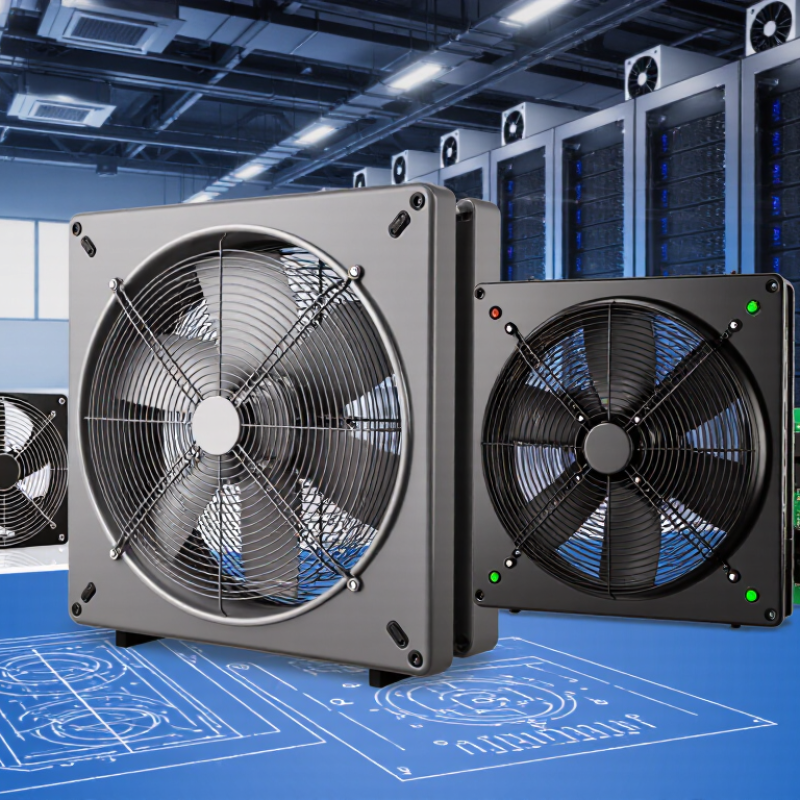
When comparing the world’s top AC and DC fan manufacturers, motor design deserves careful attention. Traditional AC fans commonly use induction motors connected directly to mains power. Their construction is familiar, durable, and relatively inexpensive. However, speed control often relies on capacitors or voltage regulation, which can reduce efficiency at lower speeds.
DC fans usually employ electronically commutated, brushless motors. An internal controller converts incoming power into precisely timed electronic pulses. Many models accept 12V, 24V, or 48V DC internally, while an adapter connects them to household AC power. This architecture supports smoother speed adjustment, quieter operation, and better low-speed performance. That distinction matters. A DC label does not automatically guarantee high efficiency.
The IEA’s Energy Efficiency 2023 report identifies electric motor systems as responsible for roughly 40% of global electricity consumption. Fan selection therefore affects more than comfort. The U.S. Department of Energy evaluates fan performance through airflow delivered per watt, rather than motor type alone. Real efficiency depends on blade geometry, bearing quality, controller losses, and operating speed. A well-designed AC fan may outperform a poorly engineered DC model at one setting. The comparison is not perfectly clean. Installation height, room size, and dust buildup also change measured results. In practical testing, buyers should compare airflow-per-watt figures, standby consumption, voltage compatibility, and control response under identical conditions. Remote controls add convenience, but wireless receivers still consume small amounts of power continuously. That detail is easy to overlook.
Technology-focused comparison of the key specifications commonly used when evaluating DC and AC fan products. Values are typical engineering ranges and may vary by fan size, airflow, pressure, motor design, and operating conditions.
| No. | Comparison Dimension | DC Fan: Typical Characteristics | AC Fan: Typical Characteristics | Purchasing and Application Implication |
|---|---|---|---|---|
| 1 | Motor Design | BLDC / EC Permanent-magnet rotor with electronic commutation and an integrated control circuit. |
Induction Usually uses a shaded-pole or permanent-split-capacitor induction motor connected directly to AC power. |
DC motor architecture generally provides more precise speed regulation and better part-load performance, while AC motors are mechanically and electrically simpler. |
| 2 | Input Voltage | Common low-voltage versions operate at 5 V, 12 V, 24 V, or 48 V DC. Larger EC systems may include an AC input with an internal rectifier. | Common single-phase input ratings include 100–120 V AC or 200–240 V AC at 50/60 Hz. Three-phase versions are also available for larger systems. | DC fans are convenient for battery, solar, vehicle, telecom, and electronic-equipment applications. AC fans are convenient for direct connection to building mains. |
| 3 | Energy Efficiency | Typical BLDC or EC fan systems can achieve approximately 50–85% motor-electrical efficiency, depending on size, speed, and load. | Typical small AC induction motors may achieve approximately 20–65% motor efficiency, with larger and higher-quality designs generally performing better. | DC or EC technology is often preferred where annual operating hours are high or where energy consumption is a major operating cost. |
| 4 | Speed Control | Usually supports PWM, 0–10 V, analog voltage, digital commands, or internal closed-loop control, depending on the controller. | Speed may be controlled through voltage reduction, phase-angle control, a tapped winding, or a variable-frequency drive on compatible motor types. | DC control is generally more precise across a wide speed range. AC control methods must be matched carefully to the motor and may increase noise or heat at low speed. |
| 5 | Operating Speed Range | Often supports a broad usable range, including low-speed operation, soft start, and programmable speed profiles. | Typically operates most efficiently near its rated frequency and load. Very low-speed operation may be limited by motor temperature, torque, or control method. | DC fans are suitable for variable-airflow systems, thermal management, and applications requiring frequent speed changes. |
| 6 | Power Factor | Small low-voltage DC fans draw power through an electronic driver. AC-input EC fans may use power-factor correction, depending on the design. | Small single-phase induction fans commonly have a lower power factor than larger industrial motors, particularly when lightly loaded. | For large installations, power factor and harmonic performance can affect electrical infrastructure, utility costs, and compliance requirements. |
| 7 | Noise and Vibration | Electronic commutation eliminates mechanical brushes and can support smooth low-speed operation; acoustic performance still depends heavily on blade and bearing design. | AC motors may generate electromagnetic hum, especially with shaded-pole designs or certain speed controllers. Fan blade balance and bearings remain major noise factors. | For offices, bedrooms, medical spaces, and recording environments, compare sound-pressure data at the same airflow and static pressure rather than comparing motor type alone. |
| 8 | Thermal Performance | Lower electrical losses can reduce motor heat generation. Some designs include thermal protection, locked-rotor protection, and automatic restart. | Induction motors can produce more heat at comparable operating points, and many designs rely on thermal protectors or impedance protection. | Lower motor temperature can improve system reliability, especially in compact enclosures, continuous-duty equipment, and high-ambient-temperature environments. |
| 9 | Reliability and Maintenance | Brushless construction avoids brush wear. Reliability depends on electronic components, bearings, protection circuits, and the quality of the power supply. | Simple AC motor designs have relatively few electronic components. Reliability depends on winding insulation, capacitors, bearings, thermal protection, and operating temperature. | DC fans can reduce mechanical maintenance but require appropriate voltage regulation and protection from electrical transients. AC fans may be easier to replace in standard mains systems. |
| 10 | Best-Fit Applications | Recommended for electronics cooling, battery-powered equipment, solar systems, data cabinets, HVAC EC systems, appliances, and applications requiring intelligent control. | Recommended for basic ventilation, household appliances, exhaust systems, industrial air movement, and installations where fixed-speed mains operation is sufficient. | The best selection should be based on airflow, static pressure, duty cycle, voltage, control requirements, sound level, ambient temperature, ingress protection, and total lifetime cost. |