How to Choose the Right DC Cross Flow Fan for Your Needs?
Choosing the right DC Cross Flow Fan can significantly impact your project's efficiency. These fans are widely used in various applications, from cooling electronics to enhancing air circulation in compact spaces. With so many options available, it’s easy to feel overwhelmed.
Understanding your specific needs is crucial. Consider the fan's dimensions, airflow capacity, and noise level. Each of these factors plays a role in how well the fan will perform in your environment. You might find some fans advertised as high-performance yet are inadequate for your requirements.
Don’t rush into a decision. Take the time to analyze the technical specifications and user reviews. While you can gather information online, firsthand experience from users can be invaluable. Reflect on your priorities. Are you looking for energy efficiency or powerful airflow? The right DC Cross Flow Fan should balance these aspects effectively.
Understanding the Basics of DC Cross Flow Fans
DC cross flow fans are essential for various applications. Their unique design creates a broad airflow, making them ideal for confined spaces. Understanding how these fans operate is critical when selecting one for your needs.
These fans work by drawing air in from both sides and exhausting it out through the front. This design allows for efficient cooling and ventilation. When choosing a fan, consider factors like airflow rate, noise levels, and energy efficiency. Each application may require different specifications, making it important to reflect on your environment.
A common mistake is overlooking the size of the fan. A fan that is too small won’t provide adequate cooling. Conversely, one that is too large can create unnecessary noise and consume excess power. Evaluating your specific requirements will guide you in making a more informed decision. Always question the compatibility of the chosen fan with your existing systems for optimal performance.
How to Choose the Right DC Cross Flow Fan for Your Needs?
| Specification |
Value |
Description |
| Size |
120mm x 40mm |
Compact size suitable for tight spaces. |
| Voltage |
12V DC |
Standard voltage for most applications. |
| Airflow |
30 CFM |
Optimal airflow for cooling efficiency. |
| Noise Level |
25 dBA |
Low noise operation, ideal for quiet environments. |
| Speed |
2000 RPM |
Speed adjustable for varying cooling needs. |
| Material |
Plastic |
Durable and lightweight construction. |
| Lifespan |
50,000 hours |
High longevity, reducing the need for replacements. |
Identifying Your Specific Airflow Requirements
When selecting a DC cross flow fan, understanding your specific airflow requirements is crucial. Begin by assessing the environment where you plan to use the fan. Is it cooling electronics, ventilating a space, or supporting a process? Each scenario demands different airflow characteristics. Ensure you know the volume of air needed to maintain optimal conditions.
Consider the air pressure you need. High-pressure applications require fans with more power. However, don't overlook the noise level. A fan that is too loud can cause disturbances. Strike a balance between airflow and sound, especially in quiet settings.
Tips: Measure the space accurately. Using precise data helps in selecting the right fan. Additionally, think about energy consumption. Some fans offer high efficiency, saving energy costs in the long run. Finally, always check installation requirements. Complicated setups might limit your options. Reflect on these factors to make an informed choice.
Airflow Requirements for DC Cross Flow Fans
This chart illustrates the different airflow requirements measured in Cubic Feet per Minute (CFM) for various applications of DC cross flow fans. Choosing the right fan depends on understanding your specific airflow needs.
Assessing Fan Efficiency and Power Consumption
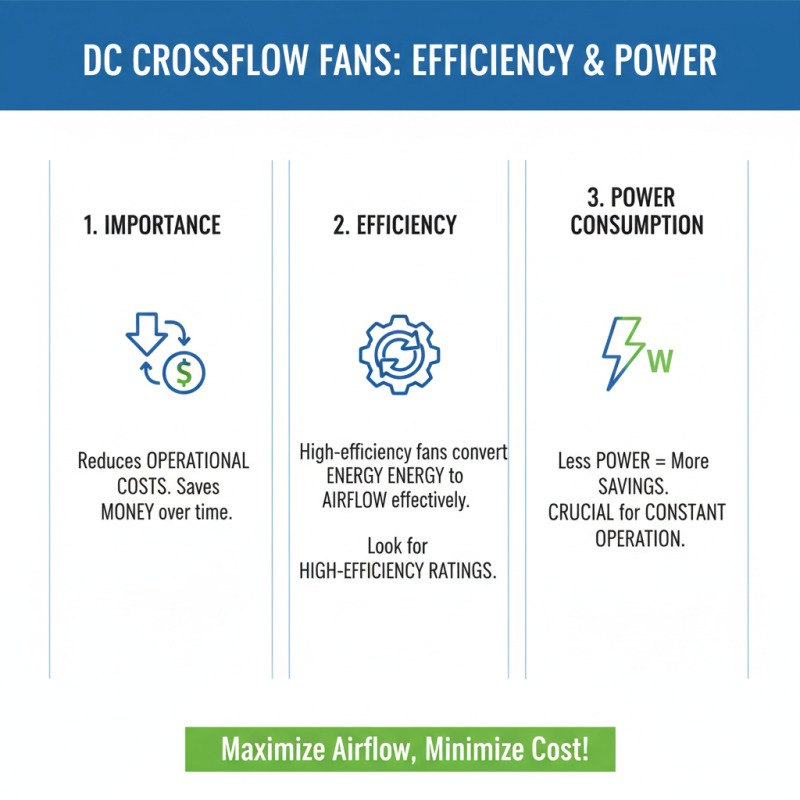
When choosing a DC cross flow fan, assessing efficiency and power consumption is crucial. Efficiency directly affects operational costs. A fan that consumes less power while delivering the desired airflow can save significant money over time. Look for fans with high-efficiency ratings, as they convert energy into airflow effectively. This is particularly important in environments where constant operation is required.
Power consumption must also align with your specific use case. For instance, in energy-sensitive applications, even a small percentage difference in consumption can lead to notable cost variances. Monitoring the specifications of the fan, such as the wattage and airflow measurements, helps in making informed selections. This process requires careful analysis and sometimes, the help of an expert familiar with various fan models and their performance metrics.
A less efficient fan may initially seem like a bargain, but hidden costs can emerge later. Incompatible fans might lead to greater wear and tear on electrical systems or inefficient cooling processes. Calculating long-term performance and costs is essential for a successful selection. Experience can guide choices, but staying informed about energy-efficient technologies will ultimately enhance reliability and effectiveness in the fan selection process.
Comparing Noise Levels and Performance Ratings
When choosing a DC cross flow fan,
noise levels and performance ratings play critical roles. Noise can significantly affect your environment.
Fans that operate quietly might be essential in spaces like offices or bedrooms.
Understanding the decibel levels of different fans is vital. A lower decibel rating often indicates a quieter fan.
This can lead to a more comfortable atmosphere.
Performance ratings highlight how efficiently a fan can move air.
CFM, or cubic feet per minute, is a standard measure.
A higher CFM translates to better airflow, which is crucial for cooling systems.
However, a fan can have a high CFM but still make more noise.
It’s essential to find a balance between airflow and auditory comfort.
Not all fans offer the same performance, and inefficient models can lead to higher energy costs.
Consider not only ratings but also the size and design of the fan.
A larger fan may provide more cooling but could also increase noise levels.
Ensure that the fan fits your specific context.
Sometimes, a smaller fan with adequate CFM can perform better than a larger, noisier model.
Reflecting on these aspects will help in selecting the right fan effectively.
Evaluating Size and Installation Considerations
When choosing a DC cross flow fan, size and installation play a vital role. Start by measuring the space where the fan will be placed. According to industry reports, incorrect sizing can lead to inefficiency, reducing performance by up to 30%. A fan too small may not move enough air, while a fan that is overly large can create excessive noise and energy costs.
Installation height is also critical. Fans should be installed at a height that allows for optimal air circulation. Reports indicate that fans installed below 7 feet often experience airflow disruption. Ensure there is adequate clearance around the fan to prevent obstructions. This can significantly affect both airflow and maintenance accessibility.
Consider the surrounding environment as well. If the fan operates in a high-dust area, choose one designed for easy cleaning. Standard DC cross flow fans may not perform well under these conditions. It's essential to evaluate your specific needs carefully. An ideal choice accounts for both size and surroundings, but the decision can often require a deeper reflection on your unique requirements.