How to Choose the Right Axial Fan Mini Fan for Your Space?
In today's diverse environment, choosing the right Axial Fan Mini Fan can significantly impact comfort and efficiency. A recent industry report indicates that about 45% of consumers struggle to find the ideal mini fan for their specific needs. Understanding airflow dynamics and size requirements is crucial for optimal performance.
Expert Tony Green, a leading figure in ventilation solutions, emphasizes, "Selecting the correct Axial Fan Mini Fan can enhance airflow efficiency and ensure comfort in any space." His insights highlight the importance of matching fan specifications with the intended application. While many overlook the significance of fan type, the right Axial Fan Mini Fan can address various challenges, from limited space to specific cooling needs.
Moreover, not all mini fans are created equal. Users often find themselves overwhelmed by the choices available. This complexity can lead to dissatisfaction. It's essential to reflect on what features matter most to you. Do you prioritize portability, noise levels, or energy efficiency? The Axial Fan Mini Fan offers a variety of options, making it vital to consider both practical needs and personal preferences.
Understanding the Basics of Axial Fans and Mini Fans
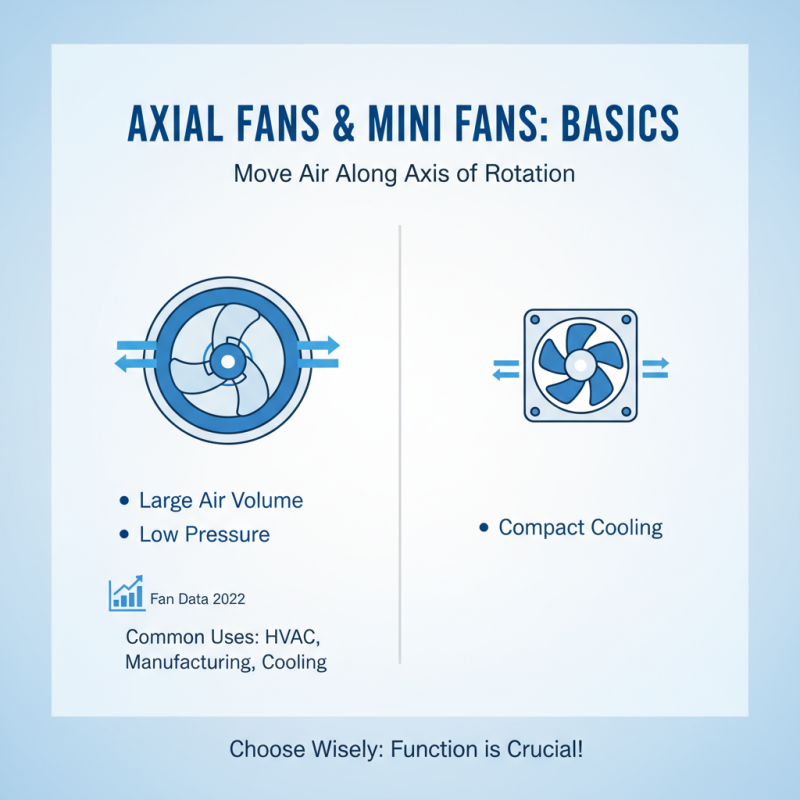
When choosing axial fans or mini fans, understanding their basic functions is crucial. Axial fans move air along the axis around which the blades rotate. They are efficient in pushing a large volume of air at low pressure. According to the Fan Data Report 2022, axial fans are commonly used in HVAC systems, manufacturing, and cooling applications.
Mini fans, on the other hand, are smaller and often portable. They can serve personal or localized cooling needs. Industry insights suggest that mini fans account for nearly 15% of the total fan market. They provide versatility for home and office use but may lack power compared to their larger counterparts. The convenience of a mini fan can sometimes lead to neglect of larger airflow needs.
When selecting a fan, consider room size. A fan that is too small won't cool effectively. A report by the Cooling Technology Association states that selecting the right size is essential for energy efficiency. Look for airflow ratings measured in cubic feet per minute (CFM). Aim for the appropriate CFM based on your space. A mismatch can lead to discomfort and higher energy costs, a mistake often overlooked by buyers. Remember, not all fans are suitable for every situation.
Identifying Your Space Requirements for Optimal Airflow
When selecting an axial mini fan, understanding your space requirements is crucial. The right fan can improve airflow and enhance comfort. For smaller rooms, a compact fan works well. These fans fit neatly on a desk or shelf and provide sufficient airflow without overwhelming the space. Open areas might need larger fans to circulate air effectively.
Tips: Measure your room before buying. Knowing the dimensions helps narrow down options. Consider the height of ceilings and the placement of furniture. Avoid cluttering pathways; a fan should be accessible.
It's important to think about noise levels too. Some fans can be quite loud. If you need a quiet environment, choose a model known for low noise. Don’t overlook airflow direction. An adjustable fan can direct air where you need it most. This flexibility is often vital in unique layouts.
Remember, a fan that works in one space may not suit another. Reflecting on your specific needs can prevent costly mistakes. Each room is unique, and finding the right fit requires some trial and error. Choosing wisely is essential.
Comparing Different Types of Axial Mini Fans Available
When selecting an axial mini fan, various types are available. Each has unique features suited for different spaces. For instance, a standard axial fan is compact. It moves air effectively in small areas, like a home office or workshop. These fans are often lightweight and portable. You can easily adjust their position.
There are also high-velocity models. They produce stronger airflow, ideal for larger rooms or garages. However, they tend to be noisier. That might be distracting if you work in silence. Another option is a low-profile fan. It mounts on walls and saves floor space. Yet, some users feel airflow is limited in height.
Consider how you will use the fan. Would you prefer a quieter model or one with stronger airflow? Take note of space limitations too. Reflect on your personal needs. Finding the right fan could take time and experimentation.
Evaluating Fan Specifications: Size, Noise Level, and Efficiency
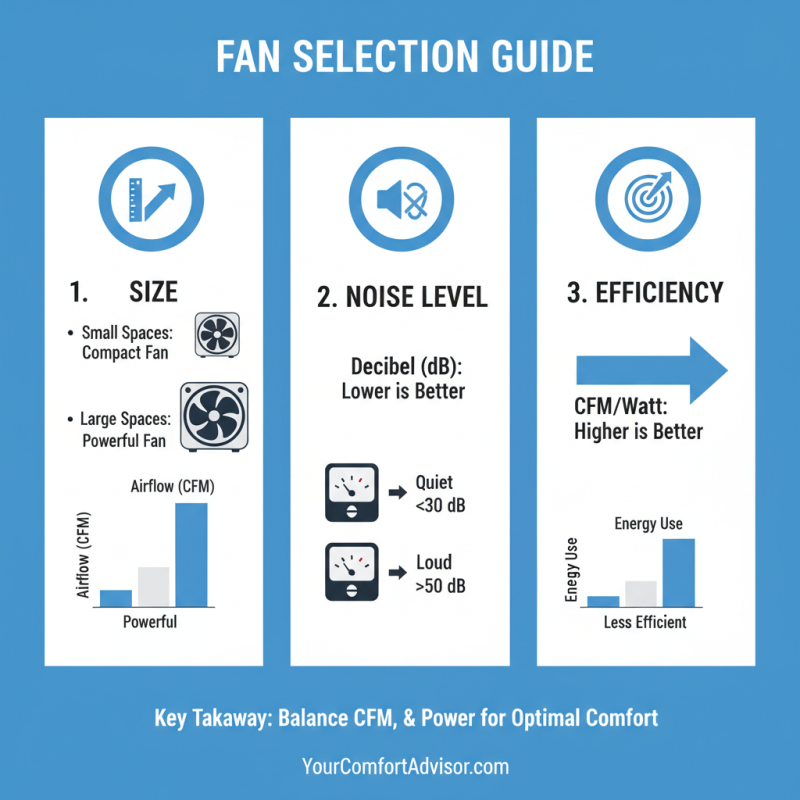
Choosing the right axial fan is essential for comfort. Evaluating fan specifications is crucial. Size plays a key role. A compact fan fits small spaces. However, larger spaces need more power. Consider the airflow rate measured in CFM (cubic feet per minute). High CFM is ideal for effective ventilation.
Noise level is another important factor. Some fans are whisper-quiet, while others produce noticeable sounds. If you work or sleep near the fan, opt for quieter models. Check decibel ratings. A sound level under 40 dB is often unobtrusive.
Efficiency matters, too. Fans with higher efficiency use less energy. Look for energy ratings. They can provide long-term savings. Remember, not all fans are created equal. It's wise to read reviews and gather feedback. Pay attention to installation and maintenance needs as well. Choosing the wrong fan can lead to disappointment. Keep these details in mind for the best choice.
Maintenance and Care Tips for Longevity of Your Axial Fan
Maintaining your axial fan is crucial for its longevity. Regular cleaning ensures optimal performance. Dust and debris can accumulate on the blades and motor, reducing airflow. Use a soft cloth or brush to gently clean these parts. Avoid harsh chemicals that could damage components. It's surprising how quickly dirt can build up and affect efficiency.
Another important aspect is checking the fan’s settings. Sometimes, fans may operate on excessive speed, leading to wear over time. Adjusting the speed to match the space can help prolong life. Listening for unusual noises is key too. Any rattling or grinding sounds can indicate potential issues that need attention. Ignoring these signs can lead to costly repairs.
Lastly, pay attention to the fan's location. Heat sources or direct sunlight can affect functionality. Ensure the fan is positioned in a way that maximizes airflow without excessive strain. It may require some trial and error to find the best spot. This kind of attention to detail can make a big difference in your axial fan’s performance.